FloridaRAMA for June's Artwalk
FloridaRAMA
Collaboration, creative trust, and letting the work become more than you imagined
June 13, 202
FloridaRAMA had been on my list for a while.
Not because it is simply an art venue, but because it feels like one of those places where Florida culture has been turned all the way up to a thousand.
You arrive at The Factory just across the Pinellas Trail from St. Petersburg's Warehouse Arts District by way of an old brick street, pull into a questionable parking situation, and watch people dressed far too nicely to be walking into an old factory building.
You are stepping inside FloridaRAMA and it makes complete sense to anyone with any experience in St. Pete.
There are bright colors everywhere. Plants. Murals. Art. A vinyl record shop. Objects from artists working throughout the Factory. A former loading dock has become a huge stepped seating area covered with colorful pillows and stuffed animals.
It is playful and loud and strange and welcoming.
It reminds me of the Florida roadside attractions I grew up with. The places where you could get strawberry shortcake, key lime pie, alligator something, Mickey Mouse something else, and probably ship a crate of fresh citrus or citrus candies to relatives up north before getting back in the car.
FloridaRAMA is not a roadside grove stand on US-27.
But spiritually?
I think they may be cousins.
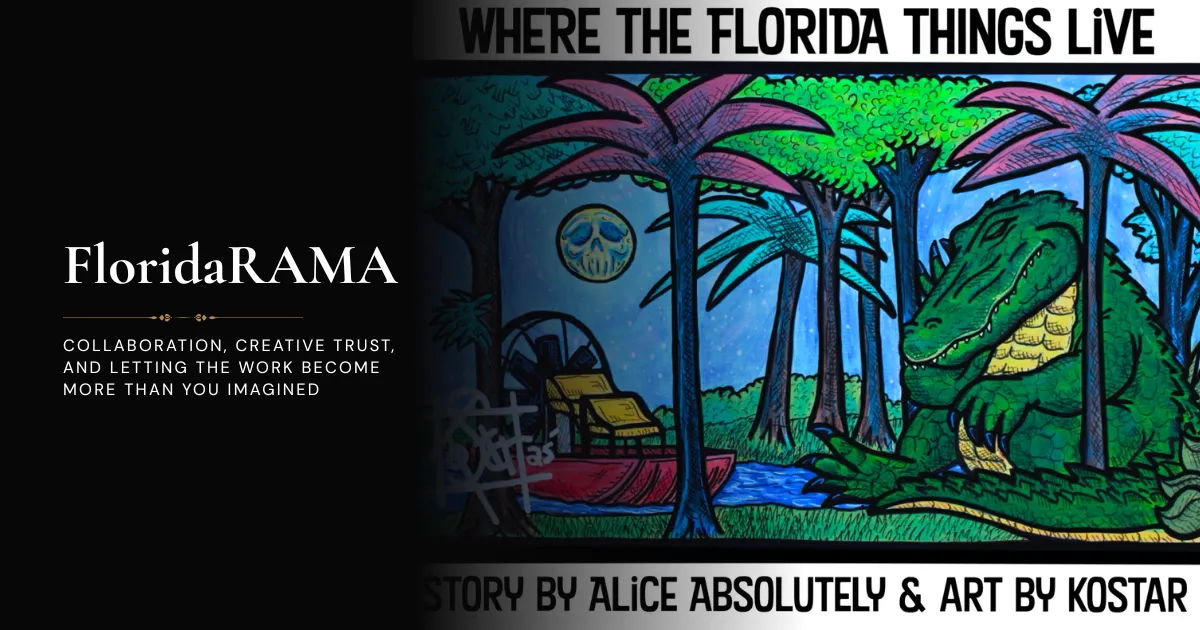
It is Florida kitsch and Florida art and Florida culture colliding inside an old industrial space, which made it a particularly good place to bring Where the Florida Things Live.
The event was also important to me for another reason. It was the first time Kostar and I had really presented the book together. I wrote Where the Florida Things Live before Kostar illustrated it. And because I am also a visual artist, that meant I had already created an entire version of the book in my own head before I handed him the manuscript.
I knew what I imagined it looking like. That made turning it over to someone else a little uncomfortable. Not because I did not trust Kostar. I did. But there is a kind of hesitation that comes with handing your work to another creative person and saying, essentially, "Here. Now you decide what this looks like."
It would have been very easy for me to over-direct the process. So I tried very hard not to be involved with the illustrations at all. I gave Kostar the text and showed him how it was divided across the pages so he knew how many illustrations the story required and which words would appear with each image. And then I got out of the way.
We did not spend hours talking about what I pictured. I did not storyboard the book with him. I did not feed him my visual ideas and then ask him to execute them. I wanted to know what he saw when he read the story. It was, after all, his idea for the book.
Eventually, Kostar sent me the entire book as pen-and-ink drawings. That was when I saw his interpretation as a whole. And it was better than the book I had built in my head. His version contained things I never would have imagined at all. Like the bull shark, who is low-key my favorite!
That is the part of collaboration that I think can be difficult for creative people. We are used to having visions. We are used to being the person responsible for making those visions real. And collaboration asks you to give up some control over that.
At FloridaRAMA, I ended up having a long conversation with a woman about exactly this. We talked about what it means to work with another creative person and how much trust is required to let someone contribute something genuinely their own. That conversation crystallized something for me that had been developing throughout the book project.
The best collaboration is not one person having an idea and another person helping execute it. It is two people bringing their own imagination to the work. Kostar did not illustrate the book I saw in my head. He illustrated the book he saw in his. And the finished work became something neither of us could have created individually.
That is a much more interesting result.
There was another thread running through the evening that I did not expect. Most of the previous readings I had done for Where the Florida Things Live were very child-centered. Story times. Holiday events. Places where children were the obvious audience. FloridaRAMA was different. There were children around, but there were also a lot of adults, and several of them immediately connected the book to Where the Wild Things Are. They talked about loving that book when they were children. Kostar and I both grew up loving it too.
And suddenly the conversation was not really about whether Where the Florida Things Live was a children's book. It was about the stories that stay with us. The books we encounter as children do not somehow stop mattering when we become adults. They help build the visual language and emotional vocabulary we carry around for the rest of our lives. Where the Wild Things Are was part of that language for me and Kostar.
Years later, that influence became part of a completely different story about Florida wildlife, conservation, imagination, and the strange creatures with whom we share this state. And then Kostar brought another imagination to it.
That is probably what I will remember most about bringing Where the Florida Things Live to FloridaRAMA. Not the reading itself. Not even seeing all of Kostar's original paintings from the book together for the first time, although that mattered to me enormously.
I will remember that creative work does not always get better when you hold onto it more tightly. Sometimes it gets better when you trust another person enough to let them surprise you. There is something very Florida about that too.
Take a warehouse that does not look like it should contain anything magical. Paint it ridiculous colors. Fill it with artists, records, murals, plants, strange objects, and an enormous couch built into an old loading dock. Then invite everyone inside.
Sometimes the things that should not quite fit together are exactly the things that make the place interesting.


