The Artist Brand Blueprint 2026
The Artist Brand Blueprint
Clarity, confidence, and learning what deserves your yes
January 30, 2026
There are a thousand things an artist can do to grow a business.
That is part of the problem.
Build a website. Post more consistently on Instagram. Apply to more shows. Improve your jury photos. Start an email list. Buy a better tent. Order ProPanels. Make prints. Take commissions. Run Facebook ads. Get into galleries. Make Reels. Improve your packaging. Go network. Do demonstrations. Say yes to opportunities. Say yes to exposure. Say yes to the person who wants a 24×36 portrait of their cat for $100 because, technically, $100 is still money.
At some point, being a professional artist can start to feel less like making art and more like standing in the middle of a room while a thousand people shout contradictory instructions at you.
And most of those instructions aren't necessarily wrong. That's what makes it difficult. A good website matters. Professional jury photographs matter. Social media can matter. A strong booth matters. But none of those things, by themselves, answer the much more important question:
What should you be doing?
That was the conversation at the center of The Artist Brand Blueprint, a workshop I taught at Notta Gallery for artists who were somewhere around that uncomfortable dividing line between making art as a hobby and trying to build a professional art career.
It is a much bigger transition than simply deciding to sell your work, because once you decide this is a business, every opportunity suddenly carries a price. Sometimes the price is money. Very often, the price is time.
And professional artists have to become exceptionally good at saying no.
When talent isn't the problem
One of the artists who attended the workshop had been working creatively for decades. He was talented. That was never the issue. He also worked constantly. He showed up at events, made new work, participated in the local art community, and had a recognizable visual language and more than enough technical ability to produce interesting things.
But his career had a pattern.
He would go all in for a couple of years: every show, every opportunity, every idea. Eventually, the sheer volume of it would become exhausting and frustrating, and he would disappear for a while.
When he returned, there would be new work, but there would also still be all the old work. And more ideas. And more directions. One booth might contain pop culture, music, horror, tattoo-inspired work, portraits, local landscapes, and completely unrelated pieces all fighting for attention. Any one of those directions might have worked. The problem was that all of them were happening at once.
That is a very easy trap for talented artists to fall into. When you can make almost anything, you start making almost everything. That sounds like freedom. From a business standpoint, it can become chaos.
People may enjoy individual pieces. They may buy a sticker because they recognize a musician they love or grab an inexpensive print because something makes them laugh. But they have a much harder time understanding you. They don't know what to expect next or what world they are entering when they follow your work. When the work, the presentation, and the artist themselves are all sending different signals, it becomes difficult for a collector to form a deeper relationship with the artist.
The answer isn't necessarily “make less art.”
It is learning what deserves your yes.
Since that class, I've watched this particular artist start making some significant changes. He has established a studio, is showing up consistently, is narrowing his focus, and has become more selective about what he takes on. He has also picked up professional illustration work.
None of those things happened because I handed him some magical Instagram strategy. There isn't one.
The more important shift was beginning to make decisions like someone building a career instead of someone chasing every possible opportunity.
When the problem is not knowing where to start
Another artist from the class was facing an almost opposite problem. She has a full-time career outside of art and would like to move toward making art professionally. She knows the environment she is currently working in isn't getting her where she wants to go, but she also understands that moving into professional art can become expensive very quickly.
A serious outdoor show setup is not a $300 experiment. A good tent, walls, weights, displays, lighting, signage, and everything else that goes into a professional booth can easily become a many-thousand-dollar investment.
So what comes first?
Does she spend money on the booth? Build a website? Buy a printer so she can produce her own prints? Invest in better photography? Spend six months trying to build an Instagram following? Make more inventory? Apply to shows? Focus instead on relationships and getting the work in front of people?
Those are financial questions, but they're also time questions. And time is the more dangerous resource to waste because you cannot make more of it.
After the workshop, she asked me to have dinner with her so we could talk specifically about her business. That conversation lasted much longer than the class, and I followed it with an equally long email.
Because once you get underneath the surface-level questions, the real issue usually isn't:
Should I buy a tent?
The real questions are: Who am I trying to reach? Where are those people? What does my work say about me? What does my presentation say about me? Do those things match?
And only then:
What do I actually need to spend money on?
Those are much better questions. They also make it much easier to say no.
Branding is not your logo
Notta Gallery originally approached this workshop from a very practical place. They wanted artists they represented to become more professional: inventory systems, collector databases, follow-up, thank-you cards, and the nuts and bolts of operating an art business.
All of those things matter. I use them. I teach them. But there are also a thousand perfectly good YouTube videos showing you how to build an inventory spreadsheet.
That isn't usually the thing preventing an artist from having a career.
The harder work happens before that.
Branding gets reduced to fonts and logos far too often. For an artist, branding is really about consistency.
Not sameness.
Consistency.
Does your work make sense alongside the way you present yourself? Does the environment where you sell it make sense? Does the audience make sense? Do your pricing, language, photographs, booth, clothing, website, and subject matter feel like they belong to the same person?
Most importantly, can the people who encounter your work understand enough about what you value to decide whether those values mean something to them too?
That matters because fine art is not usually a necessity. Nobody wakes up on Tuesday morning and discovers they urgently require a 30×40 painting before dinner. Buying original artwork is generally an elective purchase.
Something makes a person want to own that piece from that artist.
That decision is about much more than whether the colors match the couch. That is where the deeper branding conversation begins.
Professionalism is knowing what not to do
There was another moment before the workshop even started that has stuck with me. An artist came in and explained that he had a marketing background and mostly wanted a refresher. He painted landscapes and was trying to figure out what sold locally so he could paint more of it.
That approach sounds perfectly sensible if you think about art like a conventional product: find demand, produce supply, sell the product.
But a professional art career is rarely that simple.
If your entire strategy is asking, “What paintings are people buying around here?” and then making your version of those paintings, you may generate the occasional sale or commission. But you have given people very little reason to become invested in you.
There will always be another landscape painter, another beach painter, another wildlife painter, another abstract artist, another photographer, another person who can technically make the thing.
The question is why someone should keep paying attention to yours.
That requires more than marketing. It requires identity. And it requires enough clarity to know when something doesn't belong.
That's why one of the things I most want artists to leave The Artist Brand Blueprint understanding is that a successful professional art practice probably requires saying no far more often than saying yes.
No to the commission that has absolutely nothing to do with the career you're trying to build. No to the unpaid demonstration that takes three days of preparation because someone promises “exposure.” No to the mural where somebody graciously offers to buy the paint if you'll donate fifty hours of labor. No to spending six months chasing a social media algorithm because somebody told you artists have to post three reels a day. No to making fifteen new product categories because you had one slow show. No to every opportunity that looks vaguely like money.
That isn't arrogance, and it isn't laziness.
It is resource allocation.
Professional artists have limited time, limited money, and limited creative energy. Every yes consumes some of all three.
The class I actually want to teach
The workshop at Notta Gallery was only 90 minutes. It was also scheduled at 6 p.m. on a Friday night, which is approximately the moment most functioning, professional adults would prefer to be eating dinner, having a drink, or doing literally anything other than contemplating their business strategy.
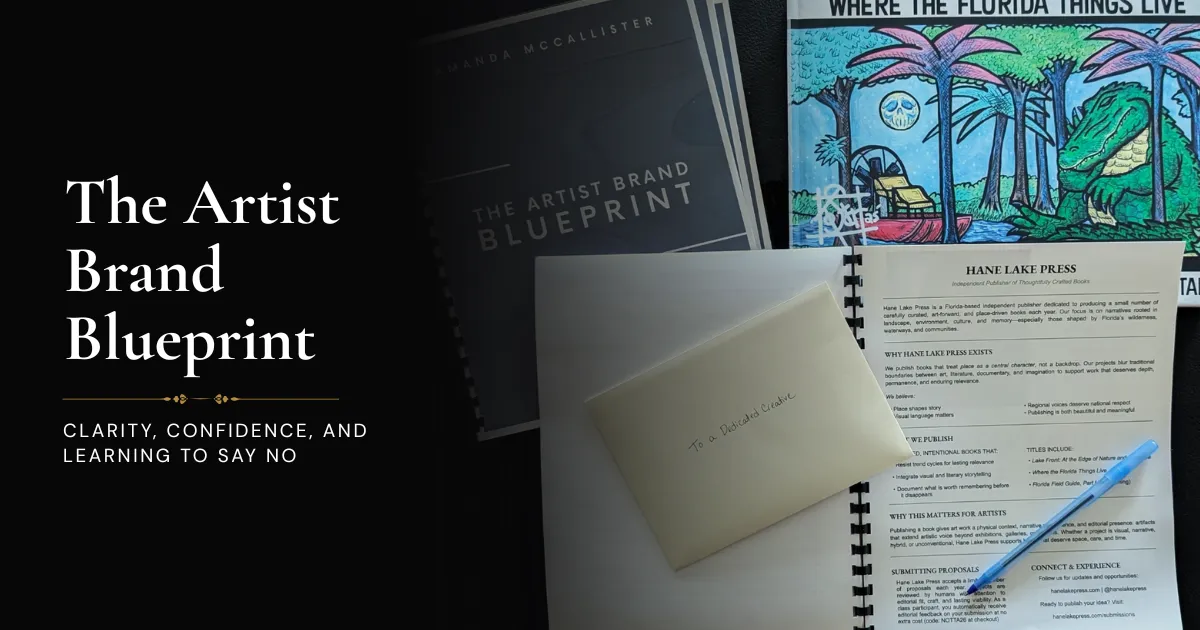
So we covered a lot in a short period. Everyone received one of the comb-bound workbooks I create for my classes, with presentation notes as well as exercises they could take home and work through later.
But the most interesting part of teaching this class has been what happened afterward.
The questions continued. The conversations got more specific. Artists began applying the ideas to their own work and realizing their problems were not necessarily the problems they thought they had.
That is the reason I want to keep teaching it.
The Artist Brand Blueprint is not really for someone who wants to spend a pleasant Saturday morning making art with friends. There is absolutely nothing wrong with that. Making art for pleasure is a completely legitimate reason to make art.
This workshop is for the person who has reached the point where that isn't enough.
It is for the artist staring at a room full of finished work and asking why it isn't selling. The artist considering leaving another career and wondering which investments actually matter. The artist doing every show, every commission, and every opportunity and wondering why they are exhausted but not progressing. The artist who knows they want a professional career but cannot figure out which of the thousand things everyone says they “should” be doing actually deserves their attention.
Those are the rooms where this conversation is useful: a gallery trying to help its represented artists become stronger professionals, an arts organization offering business development programming, a library building serious adult creative programming, a college preparing art students for the part of an art career that rarely appears in the studio curriculum, or an art league with members actively trying to move into professional practice.
The goal is not to send artists home with fifty more things to do. Most of them already have enough things to do.
The goal is clarity.
Clarity about the audience, presentation, opportunity, and where to spend limited time and money. And, maybe most importantly, enough clarity to recognize when the right business decision is simply:
No.
Because building an art career isn't about doing everything.
It's about figuring out what actually belongs to yours.


