Wildlife Art at a Teachers' Union Training?
Brevard Federation of Teachers
Care for people, care for place, and the wild Florida just outside the classroom
July 13-14, 2026
There are probably not many people who look at a union leadership training and think, You know what this needs? A Florida wildlife artist. But when the Brevard Federation of Teachers invited me to join its summer training for building representatives, the fit made more sense than it might appear at first.
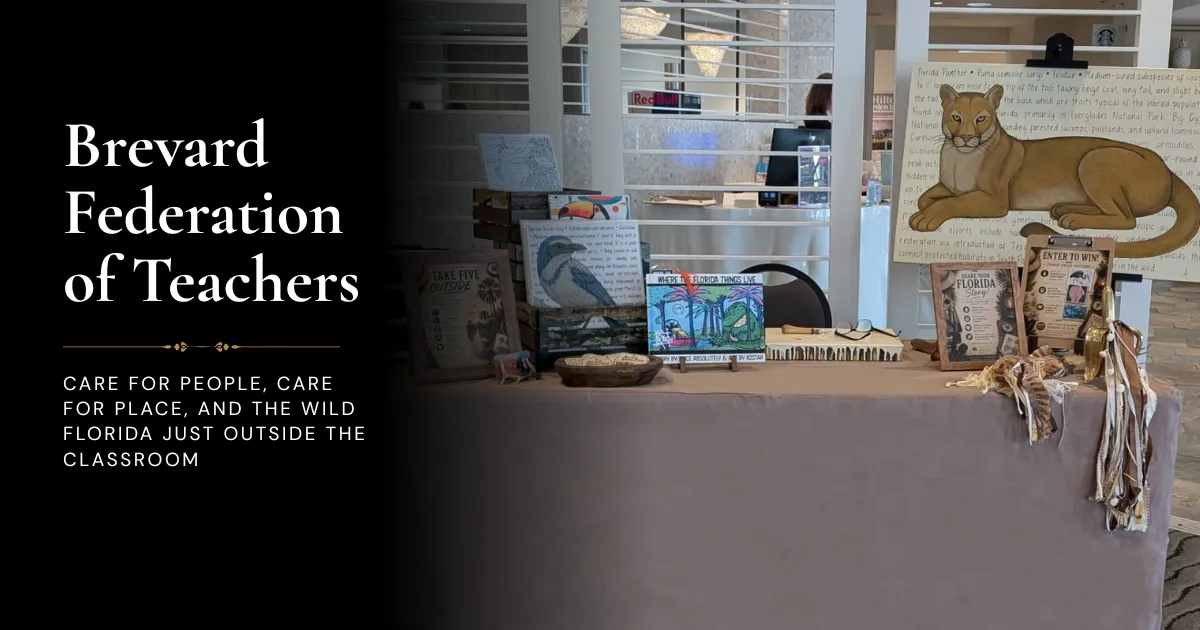
The training brought together educators who serve as representatives and leaders within their schools, and outside the main conference room BFT had created a small collection of resources focused on taking care of the people doing that work. One organization was there talking about financial well-being. Another represented health and wellness.
I decided my corner could be about another kind of well-being: getting outside, reconnecting with the place where you live, and remembering that caring for your community includes caring for the land and wildlife around it.
So I did not approach the weekend like a traditional art show. I was not there to sell.
I brought my Florida Panther carving and worked live on my Green Heron. I brought coloring pages based on Brevard County habitats and Florida Field Guide species that educators could take with them. People who joined my mailing list could enter a drawing for an 11 × 14 print or a signed copy of Where the Florida Things Live, and I donated five additional prints for BFT to giveaway to teachers at the end of the event.
Mostly, though, I talked to people.
"What is your favorite wild place in Brevard County?"
"What Florida animal do you love?"
"Where do you go when you need to get outside?"
"How does wildlife show up at your school?"
"What does protecting Florida look like to you?"
Those questions opened conversations that had very little to do with buying artwork and quite a lot to do with why I make it.
Teachers spend an extraordinary amount of time caring for other people. They are responsible for students, classrooms, families, colleagues, paperwork, schedules, testing, meetings, and all of the thousand invisible things required to keep a school functioning. The building representatives at this training had taken on an additional layers of responsibility by agreeing to advocate for the people working beside them. Not to mention union stewardship and grassroots organizing.
That is a lot of care directed outward.
I liked being there to talk about something that could turn some of that attention back toward themselves. Go outside. Take a walk somewhere wild. Learn the name of the bird you keep seeing in the retention pond. Find the preserve twenty minutes from your house that you have somehow never visited. Pay attention to what is blooming. Remember that Florida is more than traffic, subdivisions, work, errands, and the endless list of things that need to be done.
One of the things I enjoy most about the Florida Field Guide is that the artwork can be the beginning of a conversation without needing to dictate where the conversation goes. A Green Heron can become a discussion about paint carving. A Florida Panther can become a discussion about habitat loss. A coloring page can become something a teacher takes back to a classroom. A question about someone's favorite place can turn into a recommendation for a preserve I need to visit the next time I am in Brevard County.
The setting did not hurt either.
The training was held over a day and a half at the Hilton Garden Inn in Cocoa Beach, which meant I was talking about Florida wildlife and wild spaces within sight of one of the landscapes that defines the state. Brevard County has always struck me as a place where people are unusually aware of the natural world around them. The ocean, the lagoon, sea turtles, shorebirds, scrub, wetlands, and all of the wildlife threaded through those habitats are difficult to ignore. At the end of the day, I could leave the conference space and walk on the beach. That felt appropriate: I had spent the day encouraging other people to make room for Florida outside of their work, and then I got to do exactly that myself.
The Brevard Federation of Teachers training was not a sales event, and I did not want it to be. It was a chance to support a room full of people who spend their careers supporting everyone else. It was also a chance to remind them that conservation does not always begin with a policy meeting, a donation, or some enormous act of environmental advocacy. Sometimes it begins with knowing the place where you live. Sometimes it begins with taking your students outside. Sometimes it begins with noticing the bird in the parking lot. And sometimes it begins with giving yourself permission to walk down to the beach at the end of a very long day and remember that you live in Florida.


