Sometimes You Just Go Anyway
Sometimes You Just Go Anyway
Broken cameras, fieldwork, and finding the image you weren't looking for
September 10, 2026
I broke my camera this morning.
Not in some dramatic, fell-off-a-cliff kind of way. I dropped it about six inches while I was getting ready to leave the house. It landed directly on the lens. I was on my way to Archbold Biological Station for a swamp buggy tour of Buck Island Ranch. I didn't bother to check the camera. I knew deep in my soul it wasn't good. So I just got in the car and got underway. About halfway to Lake Placid, I decided to check out the camera. It was completely useless. The zoom mechanism stopped moving smoothly through the focal lengths and the focus ring could barely move.
For a few minutes, I seriously considered abandoning the entire day. I had already reached the point where biscuits and gravy with an unreasonable quantity of bacon seemed like an entirely legitimate alternative to field research. I threw a temper tantrum on the phone with my mom. Then I went to Buck Island Ranch. Without my camera.
Almost immediately, the day started to reset itself. I met Zach Franco, one of the co-hosts of the Florida Uncut podcast with Mason Gravley. I had met Mason before at a Florida Wildlife Corridor Foundation event and I listen to the podcast regularly, but I had never met Zach. He introduced himself simply as Zach, and it took me about two seconds to recognize his voice.
“Wait. Florida Uncut Zach?”
They had recently interviewed Meredith Budd from Live Wildly, so I mentioned that I am a Live Wildly Adventurist and know Meredith and enjoyed that episode. Zach immediately said he knew Reilly, and suddenly this whole overlapping conservation ecosystem opened up between us.
That is one of my favorite things about working in Florida conservation. Everybody seems to know somebody you know, everybody is doing something interesting, and people are almost always willing to stop and talk about the cool work happening in another corner of the state. After starting the morning ready to eat my feelings and go back to bed, standing there talking about podcasts, Live Wildly, conservation, and mutual friends was a pretty good emotional reset. I am enormously grateful for the conservation community I get to work in. And, BONUS, Zach was one of the tour guides for the day!
Back to overcoming the camera hurdle: there are two things I have said about photography for years. The first is that the camera doesn't take the photograph. The photographer does. The second is that the best camera to use is the one you have with you. Apparently the universe decided I needed to spend the day testing both theories.
Buck Island Ranch is an enormous working cattle ranch and research site operated by Archbold Biological Station. We climbed onto the swamp buggy and headed out across a landscape of pasture, wetlands, palms, cattle, water and enormous Florida sky. And there was wildlife everywhere.
I saw two snail kites. Several northern crested caracaras. Roseate spoonbills. Killdeer. White ibis. Cattle egrets. A great blue heron. Little blue herons. I think a couple of tricolored herons. A white-tailed doe. Monarchs and yellow sulphur butterflies. Somewhere around ninety head of Florida cracker cattle. And every single time something interesting appeared, I had the same thought. I don't have my camera.
That was especially painful because photography has become such an important part of the Florida Field Guide. The photographs are research. They become references for anatomy, posture, behavior, habitat, plant structure and composition. Sometimes I go into the field already knowing what I hope to find. Other times I come home with something completely unexpected.
Very few Florida Field Guide pieces come from one perfect photograph. The Florida black bear carving isn't three bears standing in one place waiting for me to make the photograph. It is assembled from years of looking at bears and photographing them in different parts of Florida. One image gives me the head. Another gives me the shoulder. Another helps me understand the way the fur breaks around the neck or how the weight settles through the legs.
When I look at the Florida Field Guide now, there are almost seventy-five species represented in the work--there will be 110 before the year is over for the first volume of the book to be released. It would be easy to imagine that body of reference material was collected over the last few years while I was deliberately building the project.
It wasn't. Some of those photographs are more than twenty years old. The Florida Field Guide didn't suddenly begin when I decided to give it a name. It grew out of a lifetime of paying attention to Florida. That realization changed the way I thought about the day.
Not every trip into the field has to produce the next carving. I don't have to return home with five perfect wildlife portraits, three new plant species, and an obvious composition waiting to be transferred onto a panel. Sometimes I am simply adding another layer to my understanding of this place.
So I used the camera I had. My Google Pixel 8. I photographed the landscape. I shot video from the swamp buggy. I photographed cattle and wetlands and enormous clouds moving over pasture. I couldn't reach the snail kite sitting far across the field or isolate a caracara the way I would have with a proper lens.
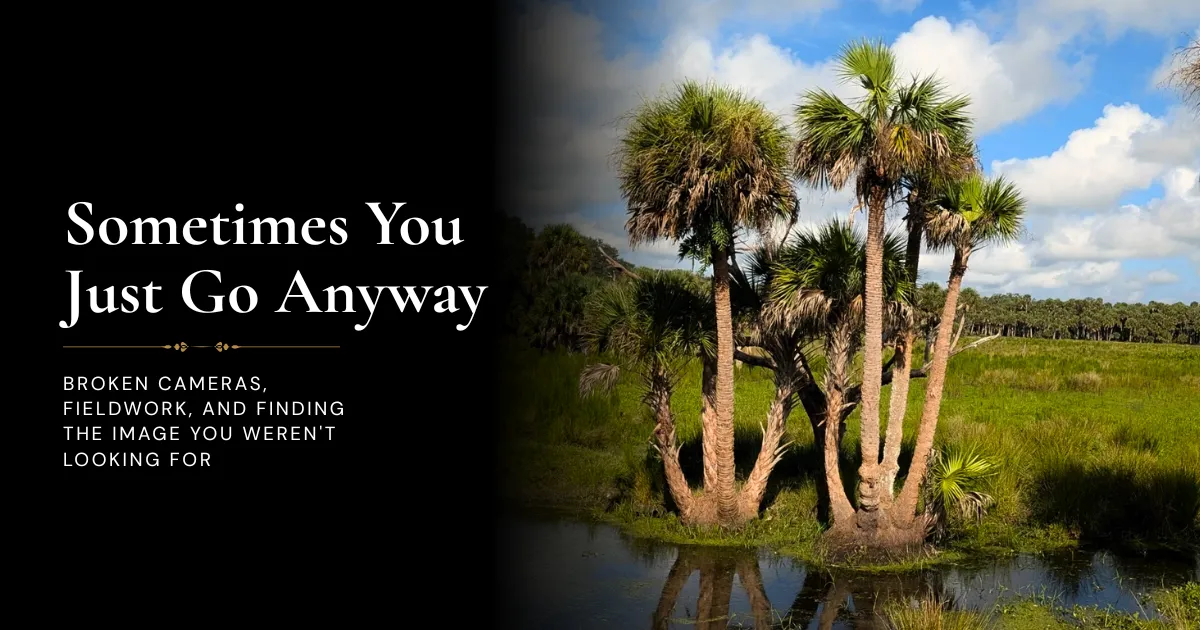
But I could still look. Somewhere along the way, I photographed a small group of sabal palms standing together at the edge of the water. Nothing spectacular was happening. There was no rare animal in the frame. No dramatic light. No perfectly timed wildlife encounter. Just palms. Their trunks divided and leaned in different directions, each tree growing according to whatever combination of water, wind, age and accident had shaped it. Their reflections dropped into the dark water beneath them. Beyond them was an open wetland and a line of palms disappearing toward the horizon. When I looked through the photographs at home, I knew immediately. That's the one. This image is what gets carved from today.
And maybe that's a useful reminder of what field work actually looks like. The photograph that becomes something isn't always the photograph you went looking for. The trip doesn't always deliver the species you expected. Sometimes the camera breaks before you even leave the house. You still go. You still look. You use whatever camera happens to be in your pocket.
Because the camera never was the thing with the artistic vision anyways.


