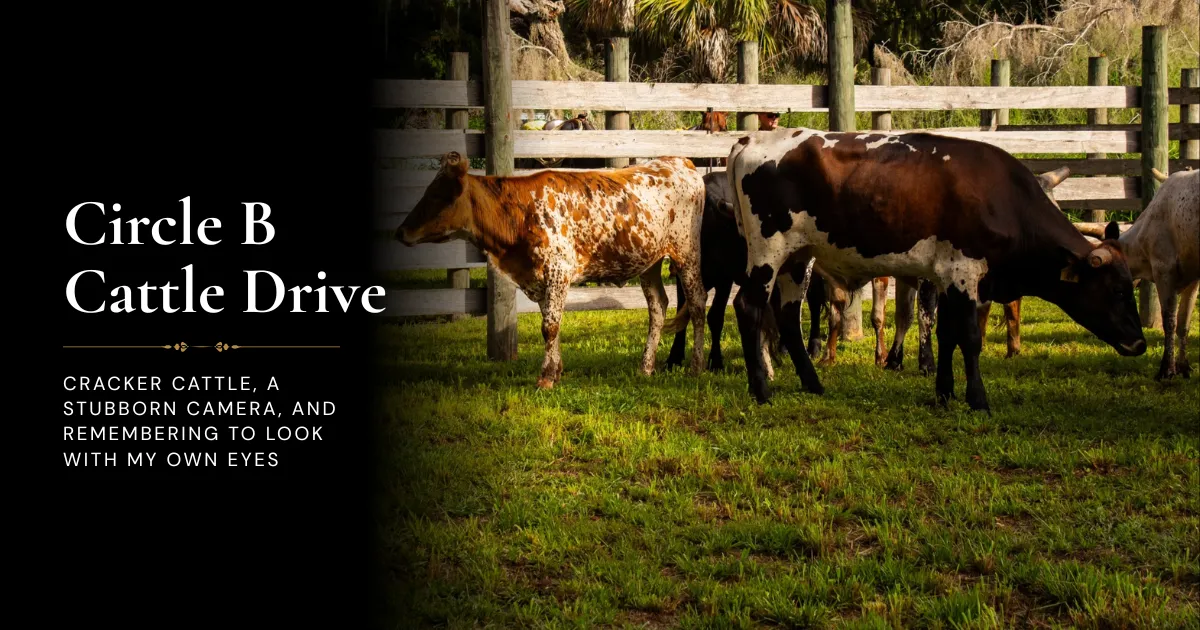
Circle B Cattle Drive
Circle B Cattle Drive
Cracker cattle, a stubborn camera, and remembering to look with my own eyes
July 1, 2026
I went to Circle B Bar Reserve in July with a fairly practical goal.
Polk County and the Polk County Cattlemen's Association were hosting a cattle drive and Cow Camp rededication as part of the celebrations for America's 250th anniversary and Polk County's 165th. The event was designed to highlight the ranching history that helped shape this part of Florida, along with the relationship between working ranchlands, wildlife habitat, and conservation.
I wanted photographs of Cracker cattle.
I have spent plenty of time around Florida agriculture, and my family owns farmland right over the Florida-Alabama state line that we lease, but I am far from being a rancher. I am much more likely to be wandering around a swamp looking for a bird or crawling toward some plant I want to photograph. I had also never actually seen a cattle drive in person. I got myself into a good viewing position, I had my camera ready, and the cattle started coming.
My camera stopped working.
Not gradually.
Not after I had taken a few good photographs.
Right then.
The cattle were coming down the road, cattlemen were moving them through Circle B, and I was standing there pressing buttons on a camera that had apparently decided it wanted no part of documenting any of this.
I was frustrated. Photography is part of my work, and field events like this are one of the ways I build the visual library behind the Florida Field Guide. I had come specifically hoping to photograph Cracker cattle, and for a few minutes it felt like I had managed to get myself into exactly the right place at exactly the right time with absolutely no ability to do anything useful with it.
Then there really was not much else to do. I put the camera down. And I watched the cattle drive. Actually watched it. Not through a viewfinder. Not while adjusting exposure or thinking about composition. Not while trying to anticipate which direction an animal was going to turn so I could get the cleaner photograph. I just stood there and watched my first cattle drive with my own eyes. That is something I have to remind myself to do.
I take photographs as part of my living. Even when photography is not the finished artwork, photographs are the beginning of it. I am constantly looking for reference material, documenting places, watching for species, thinking about what might translate into a composition later.
This creates a strange little occupational hazard where I travel somewhere interesting and spend so much time trying to preserve the experience that I forget to have the experience. I do not want to live behind the lens.
Sometimes I need the photograph. Sometimes the photograph is quite literally the reason I am there. But I also want memories that exist somewhere other than a hard drive.
The cattle drive itself was especially appropriate for Circle B. Long before it became one of Polk County's best-known nature destinations, the property was cattle ranchland. The July event intentionally connected those histories, recognizing the cattlemen and women who helped shape Polk County while also talking about how ranches and agricultural lands can provide wildlife habitat and green-space connections.
Those three Floridas are sometimes discussed as though they are completely separate: the ranching Florida, the conservation Florida, the wild Florida. In reality, the boundaries have always been messier than that.
That was not particularly new information for me, and I did not leave Circle B with some grand revelation about cattle and conservation. Mostly, I was happy to see that part of Polk County's history being demonstrated rather than simply described on a sign somewhere. There is a difference between reading about a cattle drive and hearing one coming.
And fortunately, my camera eventually decided to rejoin the festivities. Once the cattle had been moved into the pen, I was able to start taking photographs again. That was actually better for the work I needed to do. I could slow down and study individual animals rather than trying to photograph a moving herd.
What interested me most were the coats. Florida Cracker cattle can have beautiful variation in color and markings, and I wanted photographs that would let me study those differences later when I eventually develop a Florida Field Guide piece. I could look at individual faces, patches of color, patterns across the body, and the little visual differences that disappear when you are watching the whole herd move past at once.
So I got what I came for. Just not when I thought I needed to get it.
You can't always get what you want
But if you try sometimes
Well, you just might find
You get what you need.
--Mick Jagger and Keith Richards
My camera failed during the part of the morning I could simply experience, then started behaving again when I actually needed to collect reference material. Maybe that was coincidence. Maybe The Divine was involved. I am perfectly happy to treat it as instruction: Put the camera down for a minute. Look at the cows.
That is a pretty good use of a Wednesday.
By the time I left, I had photographs I could use, a better understanding of the individual cattle I eventually want to carve, and one more piece of Polk County tucked into the Florida Field Guide. But the cattle drive itself exists mostly in my head. No perfect sequence of photographs. No carefully documented approach down the road.
Just the sound, the movement, and a camera hanging uselessly from my hands.
For once, that is probably exactly how it should be.


