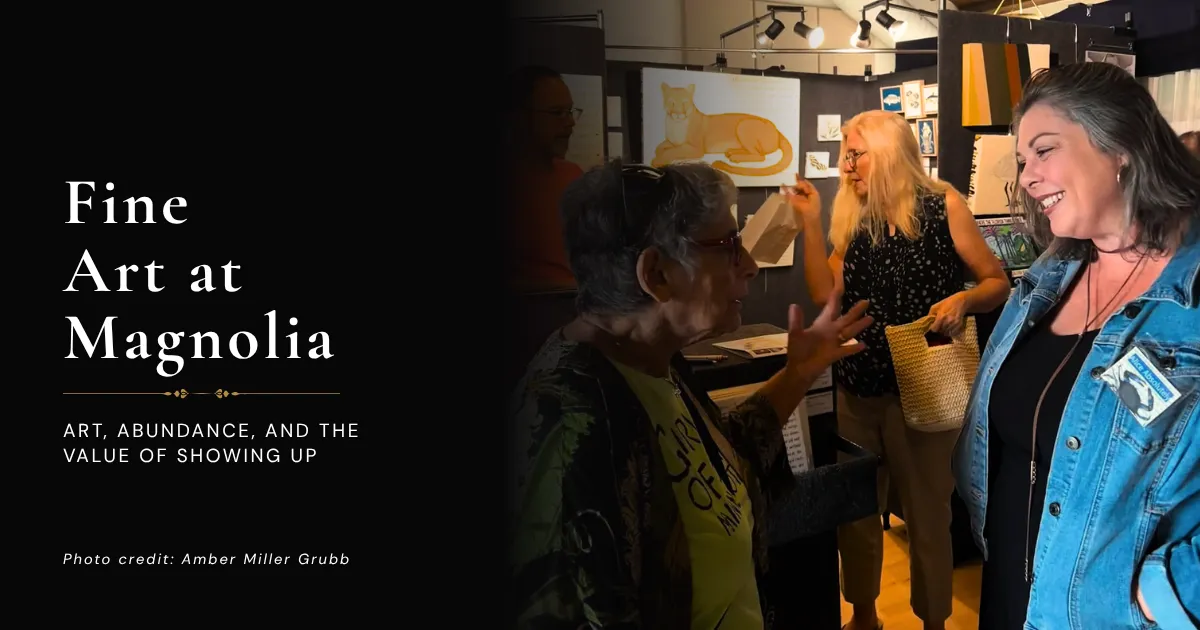
Fine Art at Magnolia 2026
Fine Art at Magnolia
Art, abundance, and the value of showing up
August 22 and 23, 2026
“Of course I always make money.”
I said that while packing up at the end of Fine Art at Magnolia, and almost immediately realized it probably sounded much more obnoxious than I intended.
Artists have this running conversation during shows. How are you doing? Have you sold anything? Has it been a good weekend? Are you making money?
And yes, Fine Art at Magnolia is an art show. I am there to sell artwork. This is my business. Selling work matters.
But when I said I always make money, I was not really talking about the number sitting in my Square account at the end of the weekend. I was talking about something larger.
Fine Art at Magnolia is an unusually small show. Just 19 invited artists gather inside a beautiful historic building in downtown Lakeland for the weekend.
There are larger art festivals. There are juried shows with dozens and dozens of artists. But Fine Art at Magnolia is intentionally intimate. You do not simply submit an application and hope your jury score is high enough. You are invited into a very small group of artists, many of whom have been doing the show together for years. There is even a name for this group.
FAM. Short for Fine Art at Magnolia. Short for family.
This year marked the show's tenth anniversary, which is an extraordinary accomplishment for Betsy Bohrer, owner of The Bohrer Gallery, and for the artists who have been showing up over the past decade. Being included in that room means something to me.
I brought the Florida Field Guide with me this year, including the first public showing of my Florida Black Bear carving, Signature Prints, Open Edition prints, and a new group of small freshwater studies.
I also launched the Florida Field Guide Society.
The Society is something I have been building for a while. Members receive two 5×7 Field Guide Proofs each month, along with field observations and Notes from the Field. The smaller prints are exclusive to the Society and designed so that, over time, they can become their own growing collection of Florida species. It was exciting to finally put it in front of people. But when I think back on the weekend, the product launch is not actually the first thing I think about.
I think about Cowboy and Kathy.
They are part of an organization called A Heart for Hero's, where horses are used in work with children and adults with disabilities and with veterans.
Their horses also paint.
Yes. The horses paint.
I immediately loved everything about this.
It is creative and slightly ridiculous and completely wonderful.
More importantly, I loved talking with Cowboy and Kathy. They were kind, enthusiastic, interested in my work, and clearly passionate about what they are doing in their own community.
Now I want to go see the horses! I want to watch them paint! I want to see what happens if somehow their process and mine collide! Maybe something comes from that. Maybe it becomes a collaborative project. Maybe no money ever changes hands at all.
That is exactly what I meant when I said I always make money. Some of the most valuable things that happen at an art show do not happen during the transaction.
A year earlier, at Fine Art at Magnolia, some of the people involved with reviewing grants for the Polk Arts and Culture Alliance came through my booth and saw my artwork firsthand. I did not know they were on the grant committee. I did not even know at the time I was going to submit a grant application.
Later, when I submitted the grant proposal involving my mobile art gallery, my work was not completely abstract to them. They had seen it. They understood what I was making and how unusual the process was.
I would not say that Fine Art at Magnolia got me that grant. It didn't. But relationships and familiarity matter. Being present matters. Letting people encounter the work matters.
Sometimes the thing that begins in an art booth does not reveal its value until months later: a commission, a sale that happens after someone has gone home and thought about a piece for three weeks, an introduction, an invitation, a horse that paints.
And sometimes it is simply getting someone back.
During the weekend, a woman walked into my booth whom I had not seen in a long time. I knew her immediately and somehow also needed a second to place her.
Judy B. Cleaves.
If you grew up around Winter Haven when I did, Judy was one of those names that seemed to be everywhere. She was a prominent local real estate agent, and I remember her signs from childhood. Years later, Judy and I served together on a Winter Haven arts and culture committee during a period when I was beginning to find my way into the arts professionally. Eventually, we both moved on from that work and lost touch. Then suddenly there she was, standing in my booth in Lakeland. There was this moment of recognition.
Wait.
You're Judy B. Cleaves.
Yes.
I'm Amanda McCallister. Do you remember me?
Of course.
And we talked. Nothing earth-shattering happened. There was no enormous professional revelation attached to it. It was simply wonderful to see someone again who had been part of an earlier version of my life.
That counts too.
I think we sometimes measure prosperity far too narrowly. Especially in business. Revenue matters. Profit matters. Artists have bills. Materials cost money. Booth fees cost money. Nobody should romanticize away the fact that a working artist needs to sell art. But a bank account is a very poor instrument for measuring everything that can happen when you put yourself and your work into a room with other people.
At Fine Art at Magnolia, I sold art. I launched something new. I showed work I had never shown before. I met people I hope to work with again. I reconnected with someone from my past. I spent a weekend surrounded by artists whose work I respect.
That feels prosperous to me.
And somewhere in all of that, I found myself thinking again about something I used to talk about much more often when I first started painting.
Hope.
When I was making abstract work, I described painting as an act of hope. That language came easily then. As my work shifted toward wildlife and the Florida Field Guide, I stopped talking about it as much. Conservation has its own vocabulary. So does natural history. So does wildlife art. But I don't think the idea ever went away. All art is an act of hope.
You make something that did not exist before and put it into the world hoping another person will understand some part of what you were trying to say.
You hope someone sees beauty in it.
You hope it makes someone remember something.
You hope it starts a conversation.
You hope it becomes part of somebody else's home, story, or life.
You reach outward and hope somebody reaches back.
That is community.
And maybe that is what I mean when I say I always make money. Not that every weekend produces the same sales numbers. They don't.
I mean I keep leaving these events richer in people, ideas, relationships, stories, possibilities, and connections than I was when I arrived. Some of those things eventually become business. Some never will. They still have value.
So congratulations to Betsy Bohrer and the entire FAM family on ten years of Fine Art at Magnolia.
If you have never been, watch for it next year. Come see the art. Buy something if you fall in love with it. Talk to the artists. Ask questions. Meet somebody you did not know when you walked through the door. And maybe leave with a little more hope than you brought in.


