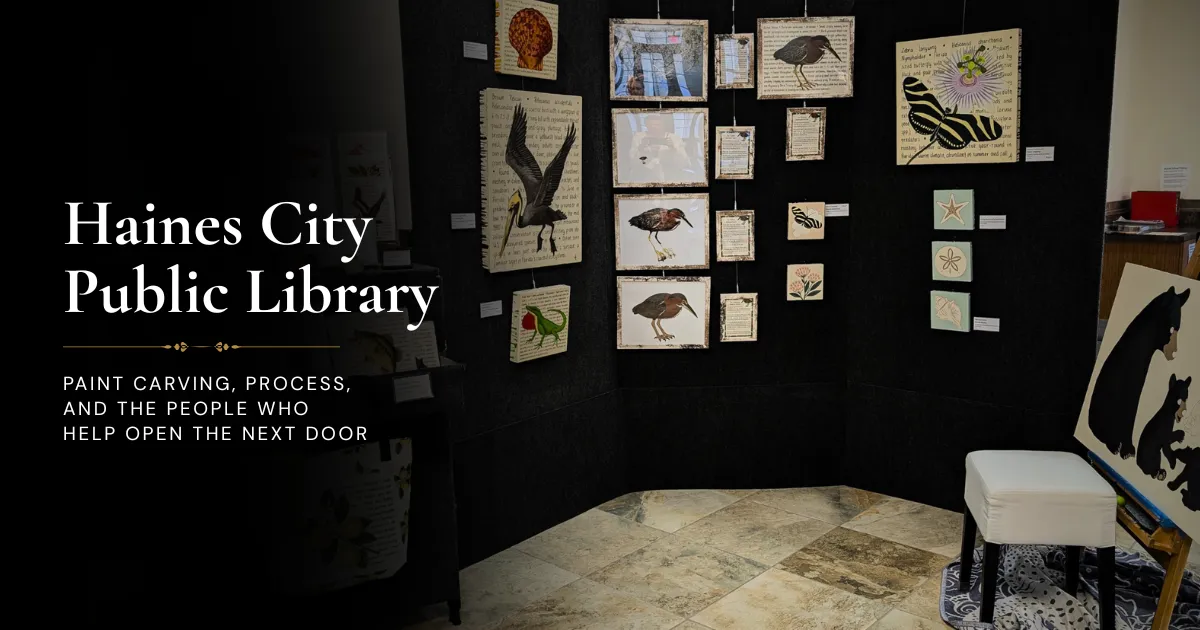
Haines City Public Library Paint Carving Demo
Haines City Public Library
Paint carving, process, and the people who help open the next door
April 22, 2026
For three hours at the Haines City Public Library, I sat in the foyer with an easel and deliberately carved through layers of paint while people came and went around me.
The Haines City stop was part of the Polk Arts and Culture Alliance Arts & Culture Impact Grant tour, but it was different from most of the places I had taken the Florida Field Guide. The grant was written broadly enough that I could use the tour to introduce people to Florida wildlife and conservation, but I could also use it to demonstrate the actual process behind the artwork.
That second piece is useful because paint carving is not a technique most people have encountered before. I have only been able to find about five other artists working professionally in anything resembling the process I use. There may certainly be more, but it is unusual enough that when people see the finished work, they often do not immediately understand what they are looking at.
So for Haines City, I brought the process with me. I set up three ProPanels with finished paint carvings, prints, and copies of Where the Florida Things Live. Then I added an easel with a work in progress and spent several hours carving live.
It was not structured as a class. There were no rows of chairs and no expectation that anyone had to sit through an hour-long presentation. It was closer to an open house. People could stop while they were coming into the library, look at the finished work, watch me carve for a while, ask whatever questions they had, and keep moving when they were ready.
That format let me show the entire process without turning it into a lecture. I could explain how a piece begins with a photograph I take in the field, how I digitally isolate the shapes and color layers, how the boards are built up with repeated layers of paint, how the species is transferred onto the surface, and then how I begin removing all of that carefully constructed paint again.
People could also handle the carving tools and look closely at the unfinished work, which makes the process much easier to understand. A finished carving can hide how strange the technique actually is. Once someone sees the layers exposed along a fresh cut, the whole thing starts making sense.
One family already had a little head start. A week earlier, a homeschool mother and two of her daughters had visited the mobile gallery at True Blue Winery. We talked about the artwork there, and I mentioned that I would be doing a live paint-carving demonstration at the Haines City Public Library the following week.
She came back. This time she brought all five of her children. That changed the interaction completely. At True Blue, they had encountered finished artwork in the middle of an ordinary day. At the library, they could see how it was actually made. The kids had questions about the carving, the tools, the wildlife, the photographs, and the steps between seeing an animal outside and eventually turning it into a finished piece of art.
I liked that progression. They did not need to sign up for a formal workshop or already know anything about art. They had seen something interesting one week, wanted to know more, and knew where to find me the next.
That is exactly the kind of thing a public library is good at facilitating. Libraries are one of the few places where curiosity does not require much commitment. You can walk over because something catches your eye, spend five minutes asking questions, or stay much longer if you get interested. Nobody expects you to buy anything. You are allowed to learn. For a process as unfamiliar as paint carving, that made the Haines City Library a particularly useful place to demonstrate it.
There was another part of the event, though, that happened before I ever unpacked a ProPanel.
I had initially tried to contact the Haines City Public Library directly about bringing the demonstration there, but I was having trouble getting through to the right person. I could not find a direct email address that gave me confidence my message was landing where it needed to go.
So I went backward.
Before retiring, Tina Peak had been the longtime director of the Lake Wales Public Library, and I had worked for her. Tina knows libraries. More importantly, Tina knows the people who have spent their careers working in them. I reached out to ask whether she happened to know the Haines City director and whether the person I was trying to contact was still the same person Tina remembered. It was. She reached out to Mary Beth herself and made the introduction for me. From there, the conversation became easy.
There is a temptation when you change careers to think you are beginning again. In some ways, you are. I was certainly not building mobile galleries or carving Florida wildlife when I worked in the Lake Wales Public Library. But a career does not erase everything that came before it. The people you worked with, the reputation you built, the relationships you maintained, and the way you treated people do not suddenly become irrelevant because your job title changes.
Sometimes those old relationships quietly become part of the infrastructure supporting the new thing. I needed help finding the right person and making a connection, and Tina was willing to go slightly out of her way to help me do that. There is something reassuring about knowing you have people like that in your corner.
Not people who will manufacture opportunities for you. People who know how you work, believe you will follow through, and are comfortable putting your name into somebody else's inbox. That kind of professional trust accumulates slowly. Then, years later, you discover you still have access to it.
By the time I packed up at the Haines City Public Library, I had spent several hours doing exactly what the grant was supposed to allow me to do: taking an unusual artistic process into a community space and letting people encounter it without much barrier between us.
Some people stopped because they liked wildlife. Some wanted to know how the carving worked. Five homeschool kids arrived ready with questions because their mother had remembered a conversation from the week before. And I got there because someone from an earlier chapter of my professional life was willing to make an introduction.
That combination feels very true to how careers actually develop. The visible part is the demonstration, the artwork, the event on the calendar. Behind it are years of learning how to do the work, photographs taken in the field, layers of paint built one at a time, people you met long ago, and relationships you did not know you would need again.
Then one morning you put all of it together in the foyer of a public library and start carving.


