Lake Wales Live April 2026
Lake Wales Live
Community, belonging, and the Old Florida I do not want to lose
April 17, 2026
Lake Wales Live is a concert series presented by the Lake Wales Arts Council in conjunction with Main Street Lake Wales. The concerts happen right in downtown Lake Wales, with the streets closed, a stage built in the middle of the intersection, lawn chairs unfolding across the pavement, and people settling in with wine and beer to listen to music under the evening sky.
It was also one of the stops I had planned for the Florida Field Guide tour through the Polk Arts and Culture Alliance Arts & Culture Impact Grant. Earlier in the year, I had run into Tommy Frank from the Lake Wales Arts Council at the Lake Wales Arts Festival. He asked how the mobile gallery was coming along, I told him the truck was finally taking shape, and we talked about bringing it out for one of the Lake Wales Live concerts.
For me, it was an easy yes. I love Lake Wales! I grew up in Winter Haven, so Lake Wales is not technically my hometown. But there is a kind of belonging that has very little to do with the place printed on your birth certificate or driver's license. Lake Wales has become one of those places for me.
A lot of that goes back to my years working at the Lake Wales Public Library and to Tina Peak, who directed the library for decades. When I first started working in Lake Wales, Tina understood something about small Polk County communities that I did not fully appreciate yet: you cannot simply arrive and expect everybody to trust you. You get introduced. You show up. You do what you said you were going to do. You stick around long enough for people to figure out who you are.
Tina went out of her way to introduce me to the people I needed to know, and over time Lake Wales stopped feeling like somewhere I worked and started feeling like somewhere I belonged.
East Polk County can be funny that way. We are made up of small communities that have spent generations watching people pass through. Florida has always attracted newcomers, tourists, developers, snowbirds, dreamers, and people who arrive convinced they have discovered something or know something nobody who lives here has ever noticed before.
Old Polk County tends to be polite about it. We'll give you a glass of sweet tea. We'll serve you a slice of key lime pie and sell you a crate of oranges. But we are perfectly happy if you keep moving--maybe a bit further south. We hear Miami is nice this time of year. Newcomers can be a little like houseguests and leftover fish. After three days, everybody starts wondering when they're leaving.
Lake Wales still carries a lot of that old Polk County temperament. The streets get quiet early. Sunday belongs to church. There are beautiful old homes, historic buildings, enormous trees, and people whose families have been connected to the community for generations. There is a deep affection for the land and wildlife that does not always announce itself as "conservation." It is simply part of how people understand the place they live.
And somehow, thanks to Tina, Lake Wales decided I could stay. That feeling was all over Lake Wales Live.
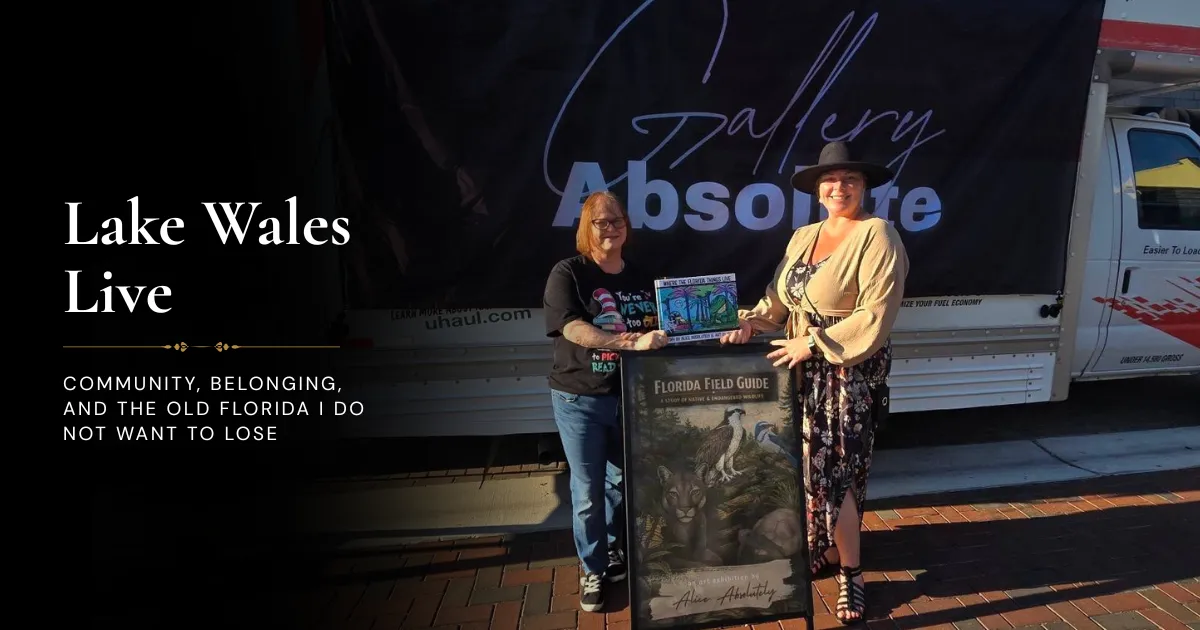
The mobile gallery was parked outside Katherine's Christian Bookstore, which stayed open late selling drinks and ice cream for the concert. I was only about one storefront down from the stage, which had been built in the intersection of Park Avenue and Market Street. A local band was playing, and I realized I knew one of the band member's wife, an artist I had not seen in more than a year.
People spread lawn chairs across the street. Wine bottles came out. Beer came out. Downtown stopped being somewhere you drove through and became a living room for the evening.
And people came to see me. There is a difference between somebody finding you at an event and somebody coming to an event because they knew you would be there. Lake Wales people tell you which one they're doing.
“I'm so glad you're here.”
“I read your newsletter.”
“I came tonight because I knew you would be here.”
Sometimes they text beforehand to tell me they are coming. There is no ambiguity.
In other places, when someone buys a piece of artwork, I will often ask whether they mind taking a photograph with me. I like having those moments for social media and for my own memories, and most people are perfectly happy to oblige.
In Lake Wales, the relationship is mutual. Before I can ask, they ask me.
“Can we take a picture with you?”
They want the photograph. They want to remember the purchase, the evening, the conversation. They want to mark the moment when the artwork became part of their lives. That stayed with me. So did seeing people from the library and reconnecting with someone I had not seen in a while because her husband happened to be playing in a band 100 feet from my truck. Lake Wales has a way of making small interactions feel personal rather than incidental.
There is comfort in a community where people want to know how your family is doing even if they have never met them. In the South people say, “How's your mom 'n dem?”
You might never have met my momma, but that is not really the point.
If you are part of the community, then the people connected to you become part of the conversation too. Somebody's grandchild needs a signed book for a birthday. Somebody wants greeting cards for a friend. Somebody sends me a photograph of the artwork they bought because they want me to see where it lives now. One woman tells me that her piece is going in the kitchen window so she can look at it while she cooks and washes dishes. Someone else wants to know when I am coming back.
Those are not monumental moments. They are evidence of a relationship becoming ordinary. I think that is why Lake Wales feels so closely connected to the work I am doing with the Florida Field Guide. The project is obviously about Florida wildlife, but wildlife is only part of it. The larger project is about memory and place. It is about what Floridians recognize as their own and what we stand to lose when a place changes so completely that the people who remember it can no longer find themselves inside it.
Lake Wales is still recognizable to me. Not untouched. No community is. But recognizable.
There are still places where the old architecture holds the street together. There are still people who understand that sandhill cranes are neighbors rather than scenery. There are still conversations that happen slowly enough to become relationships. There are still evenings when somebody closes an intersection, sets up a stage, drags a lawn chair into the road, opens a bottle of wine, and sits downtown listening to a local band.
That is Old Florida too.
We tend to reduce Old Florida to visual shorthand: citrus groves, cracker houses, cypress swamps, roadside stands, cattle, palm trees, orange blossoms.
But Old Florida is also social.
It is how people treat one another. It is knowing who belongs to whom. It is asking about somebody's momma. It is remembering who worked at the library. It is buying a piece of artwork and then sending the artist a photograph because you want her to know where you put it.
That version of Florida is becoming harder to find.
Growth is accelerating across Central Florida. Towns that once felt separated by groves, pasture, scrub, and wetlands are filling in. Roads widen. Familiar buildings disappear. Places become more efficient, more convenient, more profitable, and sometimes less themselves.
I am not interested in pretending Florida can remain frozen in time. But I am very interested in remembering what we had before we replace all of it. That is a large part of why I make the Florida Field Guide.
I want somebody to recognize the gopher tortoise. I want somebody to remember the scrub jay. I want somebody to know what pink swamp milkweed looks like. I want somebody to look at a sandhill crane and understand that it belongs to a much larger story about this place. And I want to remember communities that still feel connected to those stories.
Lake Wales is one of them.
The Florida Field Guide tour has taken me into art shows, conservation festivals, wineries, cultural spaces, and communities all over Florida. Every stop teaches me something slightly different about where the work belongs and how people respond to it.
Lake Wales Live gave me something simpler. It reminded me what it feels like to be wanted somewhere.
When people come out specifically because they know I will be there, when they ask me for the photograph, when they want to tell me where the art is going in their house, when they ask when I am coming back, I carry that with me.
Because Lake Wales is the Old, wild Florida I am working to make sure we do not forget exists.
We are losing too much of that Florida already.
I do not want to lose Lake Wales.


