North Brevard Art League Demo
North Brevard Art League
Business rules, stubbornness, and why I did not become an artist to spend all day on social media
September 16, 2026
Nobody becomes an artist because they dream of spending eight hours a day on Facebook. Nobody wakes up one morning and thinks, You know what I really want from my creative life? A million followers and a content calendar. And yet somehow, that is where an enormous amount of art-business advice leads.
Post more. Make reels. Build the email list. Start the website. Fix the website. Grow the audience. Apply to more shows. Try TikTok. Teach a class. Open an Etsy shop. Start a Patreon. Make prints. Add greeting cards. Sell stickers. Go live. Start a YouTube channel. Join every art organization within a hundred-mile radius.
More. More. More. More.
At some point, the business becomes a machine designed to keep the artist too busy to make art. And before you know it, you've become a full-time, unpaid employee in the content creation department for Meta.
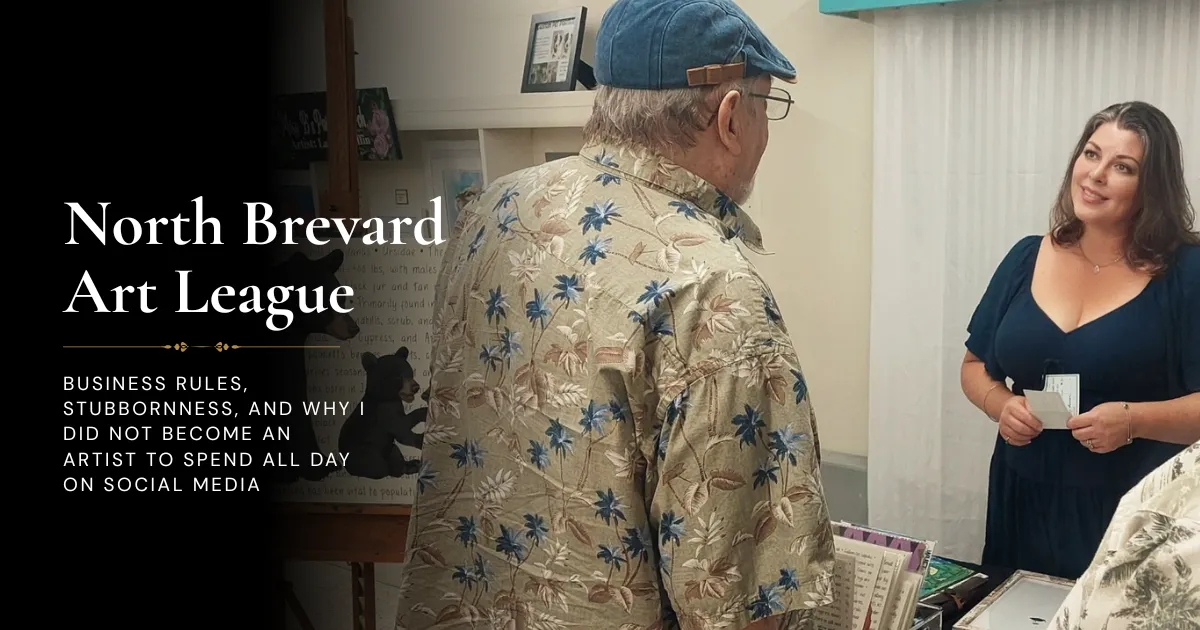
That was one of the ideas I talked about when the North Brevard Art League invited me to speak to its members as a preview of an upcoming business intensive I will be teaching for them. The timing was not exactly ideal for a sleepy presentation. Their business meeting had already been running for a while, and I was the last speaker of the evening. I started around 7:05 and wrapped up by 7:38. By that point, people had already listened to reports, announcements, organizational business, and whatever else happened before somebody said, "And now we have Amanda." Excellent. No pressure. I get it. Really I do. I know how these organizations have to operate. Honestly, I was just really grateful to be invited. I genuinely appreciate the opportunity to talk artists about their business.
So I decided very quickly that if I was going to keep a room full of artists awake at the end of a long meeting, I was going to have to be entertaining. Fortunately, sarcasm is one of my more reliable professional skills.
I started by talking about the work itself and explaining my paint-carving process. I build up layer after layer of acrylic paint, one at a time, until there is enough material on the panel to carve back through it. People inevitably look at that process and say some version of, "Wow. That is a lot of work."
"Yes! Welcome to the last vestiges of my sanity!"
There is no efficient reason to make artwork this way. I have simply chosen to become emotionally attached to a process that requires an absurd amount of preparation, precision, patience, and stubbornness. And apparently I am committed now.
That probably describes my relationship with the business side of art pretty accurately too. I caught the mail truck. I do not entirely know what to do with it, but damn it, I am not letting go!
What I have learned, though, is that refusing to fail does not mean doing everything. That distinction seemed to land with the room. When I started talking about the pressure artists feel to constantly add one more thing to their business, heads started nodding. A lot of heads.
We are told that success lives somewhere just beyond the next task. Maybe the problem is that you are not posting enough. Maybe you need better jury photographs. Maybe you need another show. Maybe you need a newsletter. Maybe you need to improve SEO. Maybe you need to sell smaller work. Maybe you need larger work. Maybe you need to make your artwork more accessible. Maybe you need to make it more exclusive. Maybe you need to create a course teaching other artists how to create courses.
At some point, everybody needs to calm down.
I have a lot of hard and fast rules about my business, and one of the biggest is that I am not interested in building a career I do not want to live inside. That sounds obvious. It is apparently not.
When people start treating their art like a business, they often begin designing the business around whatever they have been told successful artists are supposed to do. Then five years later, they have built themselves a full-time job they hate. Except now there is no HR department, no benefits, and no overtime pay.
I would like to avoid that.
One of my personal rules is that I do not work weekends. This is, admittedly, a somewhat questionable decision for a professional artist. Do you know when art shows happen? Weekends! Maybe I did not think this through.
Except I did. I simply defined the rule more carefully.
I work one weekend a month. Four weekends a year are reserved for the indoor fine-art shows I actually want to do. Another four are used for Florida Field Guide mobile-gallery events--outside, yes. But I control that calendar and they are in a truck. Not a tent. The remaining four are available for artist talks, classes, demonstrations, or other paid appearances that strengthen my authority, create relationships, or generate revenue.
Twelve weekends. That is it. I am not dragging a tent across Florida every Saturday and Sunday. I am not waking up before dawn every weekend to sit in a parking lot hoping somebody wanders into my booth. I am not saying yes simply because somebody says, "This would be great exposure."
Exposure is what happens when you forget sunscreen.
I want a reason. The weekend has to serve the business. That rule forces me to evaluate opportunities instead of collecting them. "Opportunities" are not Pokémon. And that is really the philosophy underneath most of what I teach artists about business. You do not need to do more. You need to make better decisions about what you are already doing.
That is harder than it sounds. Doing more feels productive. Saying yes feels optimistic. Adding another revenue stream feels entrepreneurial. Starting another platform feels like growth. But activity and strategy are not the same thing. A business can be incredibly busy while going absolutely nowhere.
I have seen that happen in organizations. I have seen it happen in marketing agencies. I have seen it happen with nonprofits. And I see artists do it constantly. They pursue every possible opportunity because they are afraid the one they decline might have been the one.
The magical show. The magical gallery. The magical social-media post. The magical collector who sees their booth from fifty yards away, races across the field, buys everything they have, and announces that they would also like to introduce them to the curator at MoMA.
Sure. Maybe. But probably not.
I would rather build a business that does not depend on miracles.
That means deciding what I actually want the business to produce. Money, obviously. I enjoy money. I need money. I have bills to pay. But also time, control, relationships, creative freedom, authority, access to places and people I care about, a schedule that allows me to spend actual time making artwork, and a life in which my husband and I can occasionally exist in the same room.
Those things have to be designed into the business deliberately. They do not magically appear once sales reach some imaginary number.
That is why I told the North Brevard Art League audience that the first question is not necessarily, "How do I sell more art?" The more useful question is, "What am I actually trying to build?" Because if you do not know the answer, every opportunity looks equally important. Once you do know, saying no gets much easier.
That was also why this particular talk existed. The Art League invited me out because I will be returning to teach a much deeper business intensive for their members. It is a substantial class, both in time and cost. Members are investing $200, and non-members $250. That is not an impulse purchase.
If somebody is going to spend that kind of money and give me that much of their time, I think they should know who they are getting into a room with first. So the talk served as a preview. Not a condensed version of the whole class. Absolutely not. Nice try. But enough for people to understand how I think.
I am not interested in teaching artists how to become social-media influencers. I am not going to hand out a list of fifty things they should immediately add to their schedules. I am not going to tell everyone they need the same website, the same sales model, the same show schedule, or the same career.
By the time I finished, people had laughed with me, nodded along with the parts that felt painfully familiar, and stayed engaged through the end of a long evening. Then a substantial portion of the room stood up. I was not expecting that. In fact, I had looked down at my table to start packing up and almost missed it.
I am perfectly comfortable speaking in front of people. I enjoy it. I like taking complicated ideas and making them understandable, and I like making people laugh while I do it. But there is still something strange and lovely about watching people stand to applaud because something you said connected with them.
Especially when what you were really telling them was to stop doing so much. That is the part artists needed permission to hear. You do not have to build the biggest art business. You do not have to be everywhere. You do not have to become an influencer. You do not have to turn every weekend into a sales event. You do not have to chase every phone call.
You do have to decide what kind of life you are trying to create. Then you build the business around that with strategies to make what you are willing to do work to build a successful art business.
I became an artist because I wanted to make art. I intend to keep the business from getting in the way of that.


