PAVA Cool Art Show 2026
PAVA Cool Art Show
Art, momentum, and the reward of being seen
July 18 and 19, 2026
There is satisfaction in finally doing something that has been sitting on your list for years. The PAVA Cool Art Show was one of those things for me.
I remember looking at it somewhere around 2017 or 2018, long before the Florida Field Guide existed in its current form. The show was held at the Coliseum in St. Pete. I liked the artists I saw participating. I wanted to go. Then I learned that you had to be a member of PAVA to exhibit, so I mentally put it on the list: go to the show, join PAVA, eventually apply, and someday be one of the artists standing inside that room.
Then life happened. COVID happened. My artwork changed. My career changed. The Florida Field Guide grew into something much larger than I originally imagined. Seven or eight years went by.
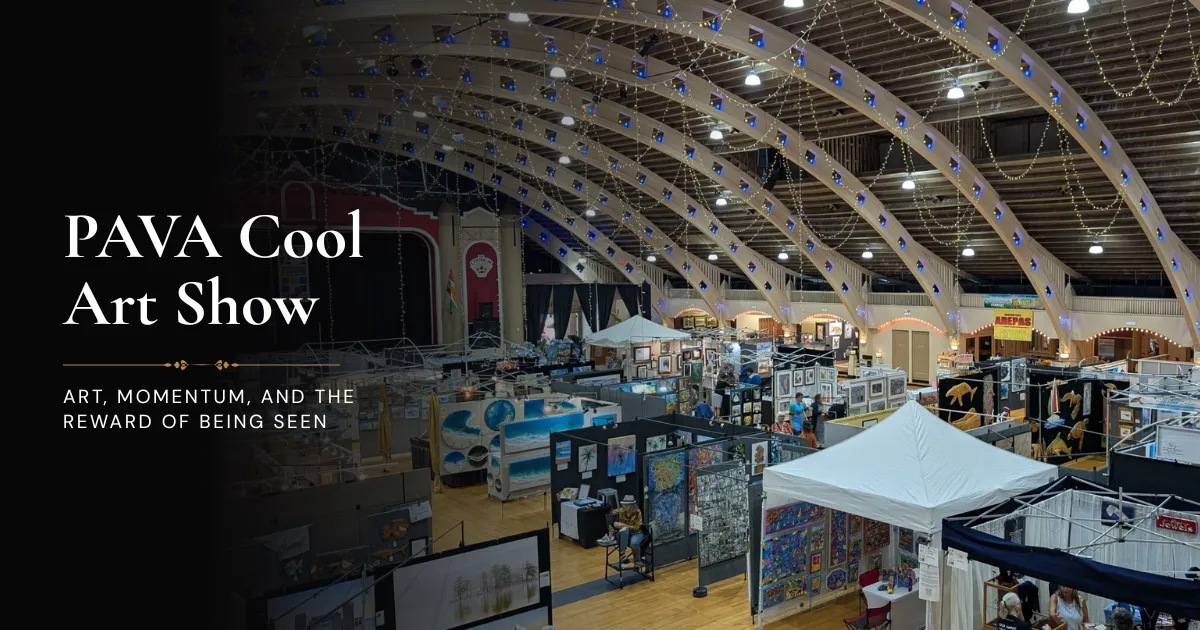
Last year, I finally went to the show as a visitor. The Coliseum itself is part of what makes the Cool Art Show special. It is a beautiful historic building with this wonderful energy to it. I sat in the lobby and watched people arrive talking about the artists they wanted to visit. The people leaving were carrying bags, packages, and boxes.
Purchases.
They came eager to see artists they knew and left carrying artwork they could not wait to take home.
This year, I applied, and I was accepted.
Skipping ahead to Sunday morning, before the doors opened, I went upstairs to the mezzanine and looked down over the entire show. Rows of booths, artwork everywhere, the old architecture of the Coliseum surrounding all of it. For a few minutes, it was completely calm.
That quiet felt particularly good because Saturday had been absolutely insane.
My booth was tucked into an alcove slightly larger than a standard 10-by-10 space, probably closer to 14 feet square. I pushed my ProPanels toward the walls and left a generous open area in the middle. At least it seemed generous until people started arriving.
The show had not even been open for an hour when my husband had about eight people gathered in the back of the booth while he explained my carving process and Signature Prints. At the same time, I was near the front talking with another six to ten people.
Within the first hour of my first PAVA Cool Art Show, there were probably sixteen to twenty people inside that booth, looking at the work, asking questions, listening to us explain what they were seeing. And then everybody started buying.
It was not exactly a mad dash for the cash register, but it wasn't far off. We were checking people out, packaging prints, answering questions, and trying to make sure everyone got what they wanted. Before that group completely cleared, another group was coming in.
At one point, people were essentially waiting for enough space to open up so they could walk inside. That had never happened to me before.
For the first three or four hours on Saturday, the booth stayed almost continuously full. The weather wasn't even particularly cooperative. There was rain. It didn't matter. People came. We did not eat lunch until around three o'clock, and the show closed at five.
It was that kind of day.
Part of what made the weekend especially interesting was that I had changed the way I presented my work. For the first time at an art show, I brought a process panel into the booth.
I originally created it for artist talks and demonstrations because people do not always understand what they are looking at when they first encounter my work. These are not traditional paintings. I build layers and layers of acrylic paint and then carve back through them, exposing the colors underneath to create the finished image.
Once people understand that, the questions start. How many layers? How long does it take? How do you know where the colors are? What happens if you carve too far?
The process panel included photographs of a piece in progress, and I also brought an unfinished carving so people could see the physical layers. At PAVA, it became incredibly useful, especially on Saturday when there were simply too many people for us to have the same fifteen-minute conversation individually with everyone who walked in.
That was also the first show where I brought the Signature Prints. These are limited-edition prints of the digital compositions I create before beginning the physical carvings. They are signed and numbered, and several are connected to conservation partners through donations from each sale. I wasn't entirely sure how people would respond. They responded very well.
People understood that they were not simply reproductions of finished paintings. They were another part of the Florida Field Guide process, a record of the composition before it became a carving. They asked about the conservation donations, wanted to know more about the species, and wanted to understand how the digital composition became the final artwork.
That is the kind of engagement I tend to find in St. Petersburg.
St. Pete has consistently been one of my most engaged audiences. People come into my booth and say, “I follow you on Instagram,” or “I get your emails,” or “I saw you at FloridaRAMA.” Sometimes it is simply, “I've been watching what you're doing.”
That means more to me than I think people realize. They usually don't expect me to remember them. They aren't demanding recognition. They just want to tell me they have been there, watching, following, paying attention.
Then they want to engage. They want to see what has changed, ask about the species or the process, or talk about something they saw me post months ago.
For an artist, that is an extraordinary gift.
Social media makes numbers incredibly visible: followers, likes, views, reach, engagement. But a number on a screen is very different from having someone walk into your booth and say, “I've been following your work for two years.”
That is a person who chose to give me some tiny piece of their attention over and over again. And now they are standing in front of me. That makes me feel seen. Mostly, it makes me incredibly grateful.
After Saturday finally slowed enough for my husband and me to eat something and talk, we realized we had also learned something about the booth. We were exhausted. Our faces hurt from talking. Because so many people had never seen the work before, we had fallen into the habit of immediately launching into an explanation.
Someone stepped inside and we started teaching. Here's what you're looking at. Here's how I make it. Here are the layers. Here's the carving. Here's the print. After several hours of that, we looked at each other and thought: maybe people are allowed to walk into an art booth and simply look at the art.
Revolutionary idea!
So Sunday, we tried giving people a little more space. Let them browse. Let them decide what caught their attention. Then have the conversation.
Sunday was quieter, so I can't make a clean comparison between the two approaches, but there was a lesson in it. Not everybody needs the same introduction. Some people want the technical explanation immediately. Some want to stand six feet away from a piece and stare at it for five minutes. Some want to know about conservation. Some want to know whether the bear comes in another size. Some just want to look.
The job isn't to give every person the same speech. The job is to pay enough attention to figure out which conversation they actually want to have.
That Sunday morning, standing on the mezzanine looking down over the Coliseum, I was thinking about all of this. But mostly, I was thinking about how lucky I was to be there.
Saturday had been a very good sales day. My show expenses were covered. Anything that happened Sunday was essentially gravy. If Sunday was even half as strong as Saturday, it was going to be an exceptional weekend.
So I stood upstairs for a few minutes and enjoyed the calm. The room looked beautiful. The booths were ready. The doors had not opened yet. After the rush of Saturday, it felt like the calm before another storm.
And I thought about how long it had taken me to stand there. Seven years. Maybe eight. So long, I had lost track.
Back when I first looked at the Cool Art Show, I was not making this work. I did not have this body of Florida wildlife carvings. I did not have Signature Prints. I did not have a process display because there was no process to explain yet. I certainly had no idea that one Saturday morning people would be waiting to get inside my booth.
There is a lot of work between putting something on your “someday” list and eventually standing in the middle of it. But occasionally you get a weekend when the distance between those two points becomes very visible.
PAVA was one of those weekends for me.
So if there is an artist whose work you love, especially someone you have been quietly following online, go see them when you have the opportunity. Walk into their booth. Look at the work in person. Buy something if you love it and it fits your life.
But even if you don't buy anything, tell them. Tell them you've been following. Tell them you remember a piece they made last year. Tell them you read their emails. Tell them you've enjoyed watching their work evolve.
You may think you are just one follower among thousands. To the artist standing on the other side of that booth, you are not. You are proof that somebody was paying attention.
And if the artist happens to be me, please come say hello. I will be thrilled to see you.
Because after years of wondering whether I would eventually make it into that room, PAVA gave me a very simple answer to a question almost every artist carries somewhere in the back of their mind:
My artwork is good enough. And people want to buy it to display it in their home.


