The Grant That Changed the Florida Field Guide
The Grant That Changed the Florida Field Guide
Validation, momentum, and the check that pushed the work out of my studio and into the world
Five thousand dollars did not transform my finances, but the obligations attached to it changed my career.
When I received an Arts & Culture Impact Grant from the Polk Arts & Culture Alliance, I had already begun building the Florida Field Guide as a body of work. I was photographing Florida species, making paint carvings, thinking seriously about conservation, and trying to understand what this project could eventually become. The grant forced me to stop thinking about eventually. Now I had to do something with it.
My first real connection to the grant came through Dr. Daryl Ward, who was then executive director of the Polk Arts & Culture Alliance. Before I ever applied, Daryl invited me to participate in a panel discussion connected to a Florida Wildlife Corridor Foundation mural unveiling at the RP Funding Center. Samara Ash, Kelly Quinn, Mason Gravley, Daryl, and I sat together talking about art, conservation, and Polk County.
The Florida Wildlife Corridor Foundation was already demonstrating something I deeply believed: art can help people care about conservation because art gives people another way into the conversation. Scientific data is essential. Policy is essential. Land acquisition and management are essential. But curiosity, emotion, recognition, and attachment matter too. I began wondering what that could look like at a much smaller scale, right here in Polk County.
Later, Daryl spoke at a State of the Arts in Polk County event in Mulberry and talked about the Arts & Culture Impact Grants. When the application opened, I took a look. Then I wrote an ambitious proposal. Possibly too ambitious.
The idea was to expand the Florida Field Guide into a gallery-style exhibition that could travel to communities across Polk County, particularly on the east side where access to traditional fine-art organizations and exhibitions can be more limited. I wanted to take conservation-centered artwork into libraries, downtown events, small businesses, community gatherings, conservation festivals, and places where someone might never intentionally walk into a gallery.
The artwork could become the invitation. From there, I could talk to people about wildlife, habitat, conservation, local culture, and the organizations already doing good work in Polk County.
Then I was awarded the grant. There is a brief moment after receiving a grant when celebration gives way to the realization that somebody has now funded the ridiculous thing you proposed. You have to do it.
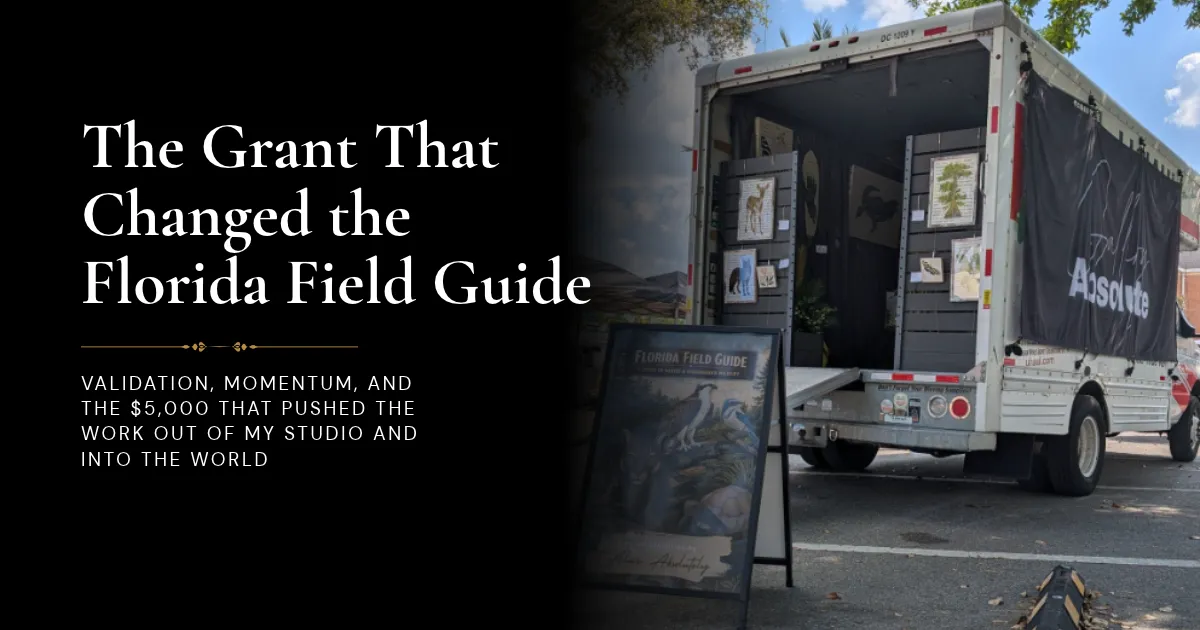
The grant helped pay for the mobile gallery buildout, U-Haul rentals, and travel. Those expenses mattered. Building a temporary gallery inside a rental truck several times a month is not free, particularly when that gallery includes hanging systems, signage, lighting, print displays, accessibility considerations, artwork, and everything else required to make the back of a U-Haul feel intentional rather than like I am moving out of my house.
But the money itself was only part of what I received. The most important thing the grant gave me was validation. I had been taking my work seriously for a long time, but there is something different about an outside organization looking at your proposal, your artwork, your experience, and your plans and saying, Yes. We believe this deserves support.
I was not dabbling. I was not a hobby artist hoping to sell a few things at a weekend market. I was building a professional art practice. Receiving the Arts & Culture Impact Grant became one of those benchmarks in my career when my internal understanding of the work finally had an external credential sitting beside it and that changed my confidence.
It also changed my emails. There is an enormous difference between contacting an organization with, "Hi, I am an artist and I have an idea," and contacting them with PACA Arts & Culture Impact Grant Award Winner sitting in the subject line. People opened those emails.
Organizations that might never have known what to do with a message from an individual artist suddenly had context. Someone else had already reviewed the project. Someone else had decided it had public value. There was a structure around the idea.
That credibility helped get the Florida Field Guide into places like the Visit Central Florida Welcome Center in Davenport. It helped me approach businesses, libraries, municipalities, arts organizations, and conservation groups with more confidence. It also changed the way larger conservation organizations encountered me and the work.
I believe it helped the Florida Wildlife Corridor Foundation see me differently. I believe it helped Live Wildly see me differently. Most importantly, it helped me see myself differently when I approached them. That may have been the most valuable part. The grant made me feel allowed to knock on certain doors. Then I learned I could keep knocking after the grant ended. The tour itself took on a life I could not have completely predicted when I wrote the application.
I took the mobile gallery to community events and conservation festivals. I parked it outside small businesses. I brought the Florida Field Guide into libraries and art organizations. I talked about paint carving. I talked about threatened species. I talked about the Florida Wildlife Corridor. I talked about Polk County arts and culture. I talked about why conservation belongs in places that do not necessarily describe themselves as conservation spaces.
Some stops were busy. Some were quiet. Some made money. Some absolutely did not. Some produced relationships that became more valuable months later.
At Sundresses in the Park in Auburndale, I finally got real photographs of the mobile gallery functioning in public, and those photographs helped lead to television coverage.
At True Blue Winery in Davenport, a small private business became one of the first places to simply say yes and give the gallery somewhere to go.
At Lake Wales Live, it became part of a community I already loved.
By the time I reached the Visit Central Florida Welcome Center, I understood the project differently than I had when I applied.
At Haines City Public Library and Studio Wildflower, the project became an educational tool.
At Seven Rivers Water Festival, a conversation about pink swamp milkweed helped push me toward deeper engagement with Florida native plants and eventually the Florida Native Plant Society.
At the Solivita Art Guild, a friend's enthusiasm turned one invitation into a packed demonstration, new mailing-list subscribers, a return invitation, and eventually a hands-on paint-carving workshop.
When storms canceled Mulberry Jams after the truck was already rented, built, and loaded, I put the entire gallery in my front yard in Lake Hamilton and invited the neighborhood over. Apparently grant administration can occasionally include redneck ingenuity.
At Fine Art at Magnolia, I launched the Field Guide Society, debuted new work, and came home with relationships, ideas, and opportunities that had nothing to do with a sales total.
I had originally imagined a travelling exhibition. What I had actually built was a platform.
The truck gave me a physical place to display the artwork, but the Florida Field Guide was becoming much larger than the walls inside it. It was creating reasons for me to meet conservationists, educators, tourism professionals, artists, business owners, librarians, nonprofit leaders, researchers, and people who simply cared about Florida. That network began influencing the artwork too.
The more time I spent in those conversations, the more clearly I understood the Florida Field Guide as a long-term body of work rather than a collection of individual wildlife carvings. Fieldwork became more intentional. Partnerships became more important. The species list grew.
Conservation organizations began influencing where I went, what I learned about, and which species I wanted to study more deeply. The project expanded into public programs, speaking, educational materials, publishing, collaborations, and relationships with people whose careers are devoted to understanding and protecting Florida.
Somewhere during that process, I found myself increasingly centered inside a community of conservationists which was not part of a line-item budget. It was still one of the grant's most significant outcomes for me.
Before the grant, conservation was already embedded in my work and in the way I understood Florida. After the grant, I had people to call. I knew who was working on wildlife corridors. I knew who cared deeply about springs. I knew people working in native plants, environmental education, land stewardship, wildlife research, and advocacy. Those people knew what I was doing too. My work had entered the conversation.
That has continued well beyond the original grant project.
The Florida Field Guide now travels farther than the Polk County stops imagined in the application. I have worked with Live Wildly as an Adventurist and creative partner. I have taken the work into conservation events, field experiences, artist talks, educational programs, and collaborations that did not exist when I wrote the original proposal. The mobile gallery itself has become one tool among many rather than the entire project.
That is probably the clearest measure of what the grant accomplished. The project outgrew the grant. I do not mean that dismissively. Quite the opposite. The best support does not create permanent dependence on the support. It gives something enough momentum to continue moving after the original funding has been spent.
The Polk Arts & Culture Alliance gave the Florida Field Guide that momentum. It gave me a deadline, accountability, and credibility. It gave me a reason to contact people I might otherwise have been too cautious to approach. It made me take an idea that existed comfortably inside my studio and test whether it could survive in public.
It could. It did. Then it kept growing.
I am deeply grateful to Daryl Ward for recognizing potential in my work before I was entirely certain what I was building, and for putting me in conversations about art and conservation that helped shape the proposal in the first place. I am grateful to the Polk Arts & Culture Alliance for funding an idea ambitious enough to scare me a little once they said yes. And I am grateful to every organization, business, community, and individual who opened a door after that.
Looking back, $5,000 seems almost comically small compared with everything that grew out of it. But that is the point of a well-thought out grant program. Sometimes an artist does not need enough money to change her life. Sometimes she needs enough support to prove that the idea deserves to leave the studio.
This grant did that for the Florida Field Guide.
And once the work got out into the world, I had no intention of leaving it back inside.


