An Artist at Rotary
Rotary on the Ridge
Business strategy, selective yeses, and why artists have to think like owners
June 8, 2026
Artists hear the word opportunity and tend to assume the correct response is yes. Say yes to the show. Say yes to the mural. Say yes to the free demonstration. Say yes to the gallery. Say yes to the podcast. Say yes to the collaboration. Say yes because maybe this will be the thing that leads to the next thing.
I do not run my business that way.
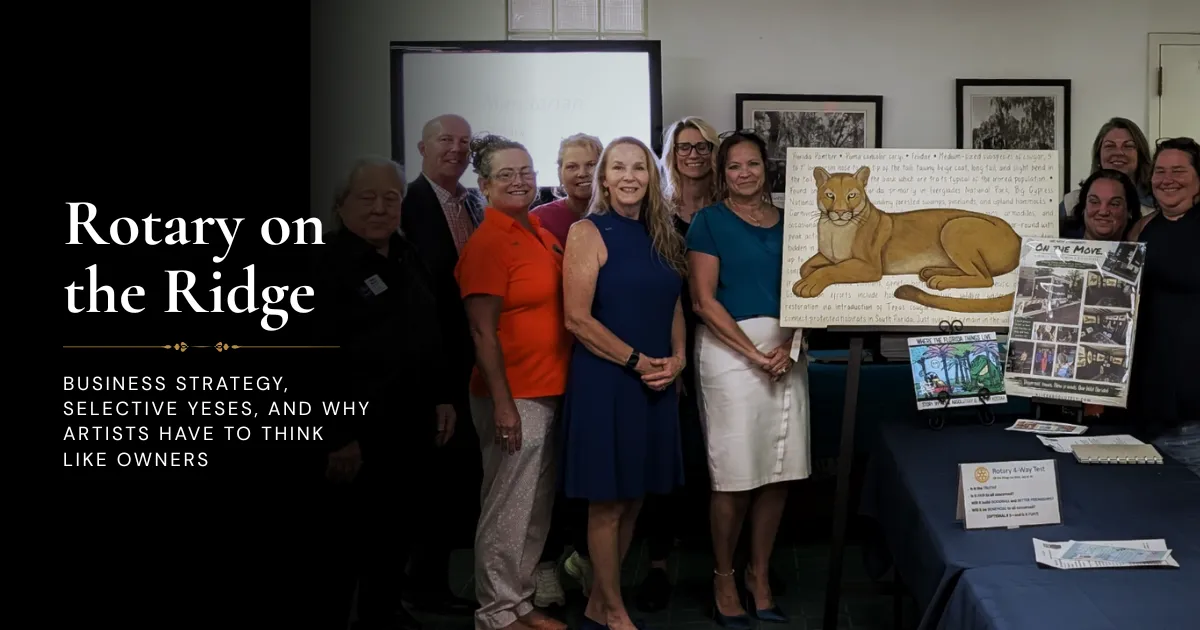
When Rotary on the Ridge invited me to speak in Lake Wales, I said yes very quickly, but not because I think every invitation deserves an answer in the affirmative. I said yes because the invitation aligned almost perfectly with the way I want people to understand my work.
The invitation started at Lake Wales Live. Terri Miller, whom I have known for years, stopped by the Florida Field Guide mobile gallery that evening and saw a copy of Where the Florida Things Live. She loved the book, bought one, and asked me about it. Somewhere in that conversation, I mentioned that I had started Hane Lake Press in order to publish it. That caught her attention.
Terri invited me to speak to Rotary about the publishing company. I agreed. Then I broadened the conversation. I certainly talked about Hane Lake Press and why I started it, but I also talked about how my art business actually works, because the publishing company is only one piece of a much larger structure. I talked about the fact that studio time does not dominate my schedule nearly as much as people might assume. A substantial amount of my time goes toward community relationships, collaborations, outreach, marketing, business infrastructure, strategy, and figuring out what deserves my attention next.
I talked about the initial personal investment required to build the business and the time it operated in the red before McCallister Ventures began paying some of that investment back. I talked about why Hane Lake Press supports me as an artist even when publishing is not the central focus of my career. Being an author and publisher strengthens my authority. It adds another layer of credibility. It gives collectors, partners, organizations, and other artists another reason to trust that I understand both the creative side of this work and the business behind it.
I do not think that was necessarily the talk everyone expected from an artist. That was the point. There is a persistent idea that artists who sell their work are artists first and business owners somewhere far down the list. I think that order is backwards. The moment you decide you want people to buy your artwork, you are operating a small business.
That does not make the artwork less meaningful. It means the business deserves the same seriousness as the work hanging on the wall. Pricing matters. Contracts matter. Cash flow matters. Time matters. Scope matters. Marketing matters. Relationships matter. And knowing when to say no matters enormously.
This is where I think a lot of artists get themselves into trouble. More does not automatically produce more. More shows do not automatically produce more sales. More commissions do not automatically build a better career. More social media does not automatically create collectors. More invitations do not automatically mean more opportunity.
Sometimes more is just more: more expense, more distraction, more exhaustion, more time spent on something that has very little relationship to where you are actually trying to go. I learned that lesson long before I started selling artwork professionally.
In education and nonprofit work, I watched organizations pursue every possible opportunity, try to solve every problem, and slowly exhaust the people responsible for keeping everything running. We built systems that helped, but there is no system good enough to completely protect you from doing too much.
Later, as a W-2 employee, I became very deliberate about scope. I did my job well, but I did not casually absorb every additional responsibility that wandered past my desk. As a business consultant, I advised clients to define deliverables, protect boundaries, build structure, and stop allowing every request to become scope creep. By the time I started treating my art practice as a serious business, those habits were already ingrained. That has been an enormous advantage. I do not believe every ringing phone represents an opportunity. Sometimes it represents a liability wearing a cute little opportunity hat. The job is figuring out the difference.
So why say yes to Rotary? Because this one fit.
I was invited because someone encountered one part of my work and wanted to understand the business behind it. The room included people accustomed to thinking in terms of organizations, strategy, finance, leadership, and growth. There were also a number of women business leaders in the audience, which made the conversation particularly satisfying.
Women in creative fields still spend a ridiculous amount of time being treated as hobbyists. That is especially true in visual art. A male artist can be eccentric and entrepreneurial. A female artist is still too often assumed to be making something pretty in her spare time. I have very little patience for that distinction. I run a business. The fact that the product happens to be artwork does not change that.
The Rotary audience was also genuinely interested in the work itself. Lake Wales is a community with a strong connection to conservation, and people were curious about the Florida Field Guide, the species I carve, and the fact that paint carving is an unusual medium practiced by a very small number of artists.
That gave me exactly the combination I wanted. The artwork opened the conversation. The business gave it depth. And the business conversation reinforced the seriousness of the artwork.
That is why this invitation was a strategic yes. Not because speaking to a Rotary Club is automatically useful. Not because visibility is always good. Not because artists should accept every chance to stand in front of a room. Because this particular room supported the way I want my career to grow. That distinction is important.
When I teach art-business classes, I am not interested in giving artists fifty more things to add to their schedules. Most of them already have too much to do. I want them to get better at deciding: What deserves your money? What deserves your time? What actually moves the business forward? What looks flattering but accomplishes nothing? What are you doing because it fits your strategy? And what are you doing simply because somebody asked? There is a difference.
Rotary on the Ridge was an easy yes because I knew exactly why I was saying it. That is the kind of yes I want more of.


