Seven Rivers Water Festival
Seven Rivers Water Festival
Wild Florida, conservation, and the unexpected value of showing up
May 2, 2026
Some events are successful because they are packed. Some are successful because you sell a lot of artwork. Some are successful because hundreds of people walk through the mobile gallery and you spend the entire day talking until your face hurts.
The Seven Rivers Water Festival was not one of those events.
It was hot. Exceptionally hot. Heat-advisory hot.
There were storms in the forecast that never actually showed up, which was great once we were there, but not particularly helpful when people were deciding whether they wanted to leave their air-conditioned houses and spend the day outside. The crowds were small.
And yet, when I look back at the stops I made during the Polk Arts and Culture Alliance Arts Impact Grant tour, Seven Rivers may have been one of the more important ones.
Part of that is simply because it was home.
The festival was held at Lake Silver in Winter Haven (adjacent to the Chain of Lakes), and I grew up on those lakes. That landscape is part of my understanding of Florida. Long before I was thinking about Florida wildlife as an artist, long before there was a Florida Field Guide, the Chain of Lakes was simply where I lived. It was boats and docks and alligators and birds and water, the ordinary background of growing up in Winter Haven.
So bringing the mobile art gallery there, especially early in the grant tour, felt a little like bringing the project home.
It was also different from almost every other stop I was making. This was not an art festival that happened to let me talk about conservation. It was not a community event where I happened to park a mobile gallery. It was not a winery parking lot or a visitor center where art was the primary reason I was there.
Seven Rivers was a conservation event.
And I was there with wildlife art.
That distinction mattered to me.
Around the festival were organizations talking about water, wildlife and environmental issues. There was information about mosquito control. The Southwest Florida Water Management District was there. Gatorland brought animals. Vendors and organizations were approaching Florida's relationship with water from completely different directions.
And, because Florida apparently cannot have a water festival without introducing an element of absurdity, there was a cardboard boat race.
People built boats out of cardboard, climbed into them, and attempted to paddle out into the lake, turn around and make it back. It was exactly the kind of thing that makes perfect sense once you are standing beside a Florida lake watching it happen.
In the middle of all of that was my mobile art gallery.
At first, I was not entirely sure what my role was. I had artwork. People could walk through the gallery. They could learn about the Florida species in the work. They could buy something if they wanted to.
That was essentially my plan.
At an art show, that is a perfectly reasonable plan. At a conservation festival, I started to realize it might not be enough. Everyone around me had something people could do. There were animals to see, demonstrations, information to pick up, and conversations about water, habitat and what was happening in the ecosystems around us.
And then there was me saying, essentially: Here is some art.
I began thinking about what it means to bring an art practice into a conservation space. If the Florida Field Guide is supposed to connect people more deeply with the species and places around them, then the experience cannot always stop at looking at a painting.
Seven Rivers made me realize that I needed another layer. I needed ways for people to interact with the ideas behind the artwork. I did not have that figured out that day, but I left knowing I needed to. That realization alone would have made the festival worthwhile.
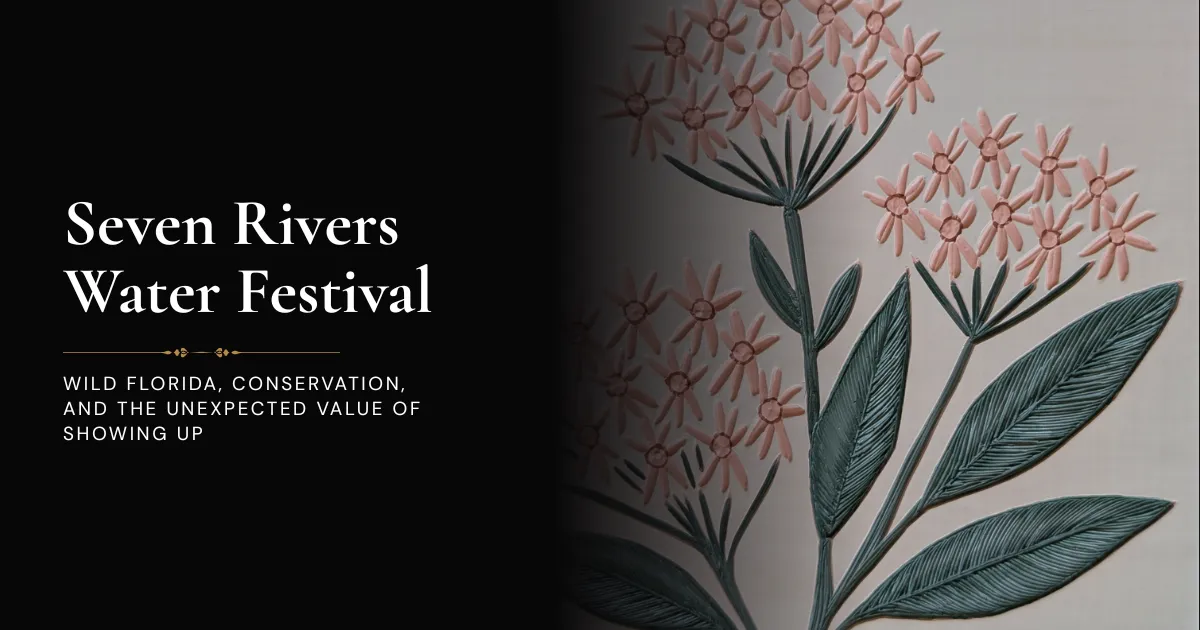
Then a man walked into my gallery and looked at one of my botanical carvings.
“Pink swamp milkweed.”
Immediately.
Not, “That's a pretty flower.” Not, “Is that milkweed?” He knew exactly what it was, well enough to start talking about it by its scientific name. This presented a slight problem for me because botanical carvings are one of the areas of my work where I am particularly capable of getting inside my own head.
I am much more confident carving an animal. Plants make me nervous. Flowers have geometry. Petals have very particular structures. A botanically literate person knows when something is wrong in ways that someone casually looking at a flower often does not.
So naturally, I had convinced myself that my plant carvings weren't particularly good. And because artists are excellent at casually telling complete strangers about the things we think we are terrible at, I said some version of that to him. He looked at the carving and essentially told me I was ridiculous. The geometry of the flowers was right. He had identified it immediately. What exactly was I worried about?
Then he wanted to know where I had photographed the plant. We talked about native plants and the artwork, and eventually he asked whether I had ever done anything with the Florida Native Plant Society. Had I thought about becoming a vendor? Had I considered their conference?
I had thought about it. Loosely. In the abstract. In the way you think about something and then immediately produce fifteen reasons you are probably not qualified to do it. Because, again: plants.
So I did what any reasonable person with a stranger standing in front of her enthusiastically telling her to pursue an opportunity does. I more or less blew it off. Not rudely. I heard him. I appreciated it. I just did not think very much was going to come of it.
Then something interesting started happening.
Other people brought it up. Not as part of some coordinated campaign to make me exhibit with the Florida Native Plant Society. Just people appearing in my orbit and independently saying some version of the same thing: You should talk to FNPS. Your work would fit there. You should consider their conference.
Eventually, when multiple unrelated people keep pointing you toward the same door, it becomes a little silly to keep pretending you cannot see it.
So I applied. And now I am an approved vendor for the 2027 Florida Native Plant Society conference in Daytona Beach.
That path started, at least in my mind, with a brutally hot day at a relatively small festival in Winter Haven and one person who walked into my gallery and recognized a pink swamp milkweed.
I think about that often when I am trying to decide whether an event was “worth it.”
It is easy to look at attendance. It is easy to look at sales. Those numbers are clean. A small crowd looks unsuccessful. A hot day looks unsuccessful. A day where you do not sell as much artwork as you would at a major fine art show looks unsuccessful. But those measurements only tell you what happened that day. They do not tell you what the day started.
Seven Rivers started at least two things for me.
One was practical. It changed how I think about conservation events. I realized that bringing wildlife artwork into those spaces is not enough by itself. I want people to have a way to engage more directly with the species, the ideas and the conservation story behind the work. That realization has shaped how I am approaching future events.
The second was more personal. The festival pushed against one of those little pockets of insecurity that every artist carries around. Mine happened to involve plants. I did not suddenly leave Seven Rivers believing I was the world's greatest botanical artist. But somebody who knew what he was looking at walked into my booth, identified the plant immediately, and told me the thing I had been worrying about was precisely the thing I had gotten right.
Sometimes you need that. Not empty praise. Not someone telling you everything you make is wonderful. Someone with enough knowledge to look at the work and say: No. This part works. Keep going.
There is also something particularly appropriate about that happening in Winter Haven. The mobile gallery existed because of a Polk Arts and Culture Alliance grant. I was taking it around Polk County and beyond, learning in real time what this project could become. One of the early lessons happened right back by the Chain of Lakes where so much of my relationship with Florida began.
That is what made Seven Rivers important to me.
I arrived there fulfilling a stop on a grant tour. I left thinking more seriously about what it means to show up in conservation spaces not merely as an artist who paints wildlife, but as someone using art to participate in conservation conversations. There is a difference.
I am still figuring out exactly what that looks like, and I probably always will be. But sometimes the event that looks small on the calendar becomes much larger after you have had enough time to see where it leads.
Seven Rivers was one of those days.


