Studio Wildflower Hospitality, curiosity, and the art of making room at the table
Studio Wildflower
Hospitality, curiosity, and the art of making room at the table
April 29, 2026
Studio Wildflower does not really feel like a gallery.
It is a gallery, certainly. There is artwork on the walls, members have places to display their work, classes happen there, and some artists have working spaces inside. But when I went to Frostproof to give a paint-carving demonstration, the room did not feel like a formal art space.
It felt like somebody's house.
More specifically, it felt like somebody's dining room when everyone has already pulled up a chair and decided they are staying awhile.
Studio Wildflower occupies this enormous, light-filled space in downtown Frostproof, a tiny Polk County town where I honestly was not sure what kind of turnout to expect. This was another stop on the Florida Field Guide Tour sponsored by the Polk Arts and Culture Alliance through their Arts and Culture Impact grant. I knew the space had a committed group of artists behind it, but small town plus specialized art demonstration does not necessarily equal a crowd. So I went in without expecting much. I was wrong. People showed up!
Not just a couple of people either. There was a real audience, and what struck me almost immediately was how broad that audience was. There were men and women, teenagers, working-age adults, retirees, and people well into their seventies. That is unusual for the kinds of demonstrations and talks I give. Sometimes I am speaking to an art group that skews almost entirely female. Sometimes I am at an event where the audience is primarily couples. Studio Wildflower had a much wider mix. And everybody sat down together.
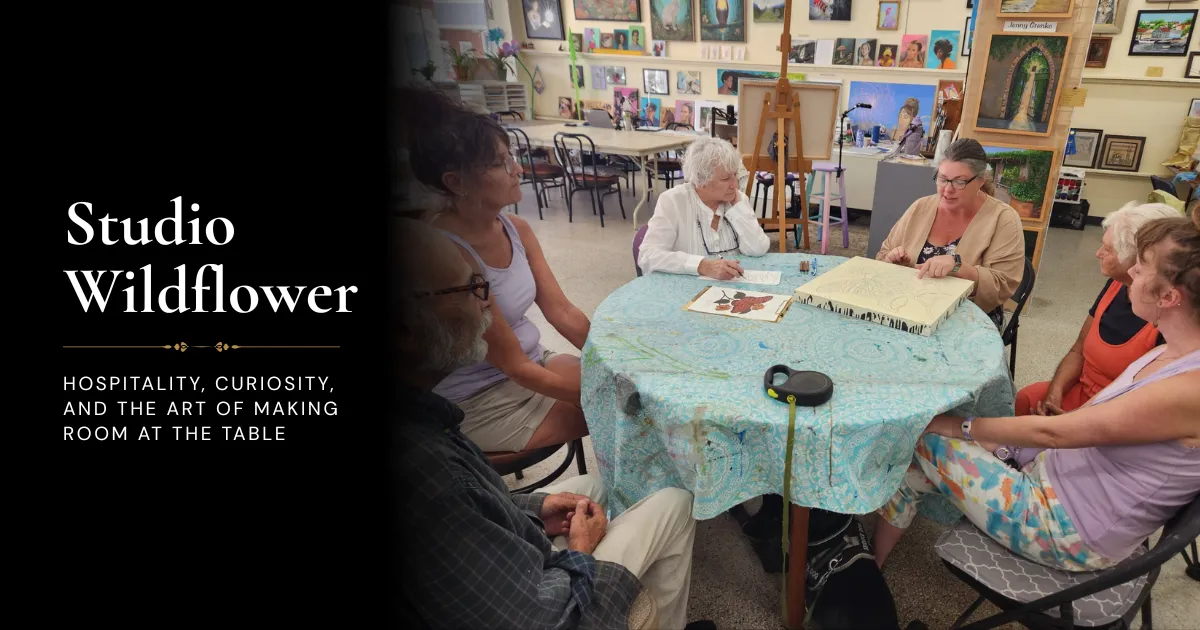
The first part of the demonstration happened around a long table in the middle of the room. Technically, I suppose you could call it a worktable. In another setting, it might have felt like a conference table. Here, it did not. It felt like a dinner table.
I was standing at one side talking about my Green Heron carving and explaining how a piece begins with a photograph taken in the field, becomes a digital composition, gets translated into layers of paint, and then eventually gets carved back down again. But the physical arrangement changed the way the conversation felt. Everybody was sitting together rather than facing me in rows. I was not standing at a podium. There was no real separation between "speaker" and "audience."
I felt less like I was giving a lecture and more like I had stood up at dinner to tell a story. That feeling had very little to do with furniture. It came from the people. The hospitality started almost immediately.
"What can we get you to drink?"
"Would you like something to eat?"
"Here's what we have in the refrigerator."
"Make yourself comfortable."
It reminded me of being a teenager in the late 1990s and bringing friends home after school. My mother fed everybody. There was no vague, polite offer of "Would anyone like something?" followed by everyone saying no because they did not want to impose. Nope. My mother would start listing inventory!
"We have Pepsi, Diet Pepsi, Dr. Pepper, lemonade, water, and sweet tea. What do you want?"
Then came the food.
"I just made brownies. There is fruit. There are Cheez-Its. We have Doritos. I can make nachos. Do you want ground beef on them?"
That was the energy at Studio Wildflower.
I have been to plenty of art events with food. Galleries put out wine and hors d'oeuvres for opening receptions. Organizations offer coffee before meetings. Demonstrations occasionally come with snacks. This was different. This was hospitality as instinct. You are here, therefore we are going to make sure you are comfortable.
I think "Jacque" Olesak Palomaki has a lot to do with that culture. Jacque is the mother of someone I knew loosely in high school, although Jacque and I had never actually met back then. Sharon, another Studio Wildflower artist, is part of it too. Sharon also happens to be the woman from whom I bought my house, which is one of those very Polk County connections that sounds more complicated than it actually is.
I found my house because an artist friend shared Sharon's Facebook post when she decided to sell it. Sharon and I stayed friends after the sale, and she has become a strong supporter of my artwork. When the original date for the Studio Wildflower demonstration conflicted with travel plans that would keep Sharon from attending, we actually moved the demonstration so she could be there. She also promoted it. A lot. I suspect Sharon had more than a little to do with why so many people showed up that day.
Now Alexa is leading Studio Wildflower with this young, energetic presence of her own, and what I like is that she seems to understand the value of the culture she inherited. She is not trying to professionalize the warmth out of the place. That would be very easy to do.
Art organizations sometimes get so focused on looking serious that they accidentally make themselves inhospitable. Everything becomes white walls and careful language and invisible rules about how long you are supposed to stand in front of something before moving on. Studio Wildflower does not seem particularly interested in any of that. Come in. Sit down. Would you like something to drink? What are you working on at the moment?
That openness carried directly into the demonstration. I had originally planned to walk people through my process in something approaching chronological order. Start with the photograph. Move into the digital composition. Talk about preparing the board. Explain the layers. Show the drawing. Then demonstrate the carving. A nice clean progression.
The audience had other plans. They asked questions. A lot of questions. And I encouraged it. I have learned that if someone has a question rattling around in their head, there is a very good chance they are not actually listening to whatever I say next. They are waiting for the moment when they can finally ask the thing they are thinking about. So I tell people to interrupt me. If you have a question, ask it when you have it. That destroys any hope I have of delivering a perfectly linear explanation of the process. I am increasingly convinced that is a good thing.
At Studio Wildflower, the conversation wandered all over the place because people were genuinely curious. Someone would ask something about the digital composition that pulled us backward. Another person would ask about the physical paint layers. Someone else would want to know about a tool, the color sequence, the carving depth, or what happens when something goes wrong. Then someone else's question would trigger another question from across the table.
Instead of me deciding what everybody needed to know, the room told me what they actually wanted to know. There is a real difference between those two things. When I prepare a talk, I make assumptions. People probably do not understand this, so I should explain it. This part is unusual, so they will probably ask about that. I have told this story before, and audiences usually respond here. But every audience brings its own curiosity. At Studio Wildflower, I had to follow theirs. That made me think differently too.
Sometimes somebody asks a question about my process that I have never been asked before, and I realize I have been doing something automatically for years without ever articulating why. Suddenly I have to stop, look at my own work from the outside, and explain a decision I usually make instinctively. That is useful for me.
Later, we moved away from the long table and gathered tightly around a smaller round one while I worked on my Gulf Fritillary carving. Everyone could get close enough to see what the tools were actually doing to the surface. The room got smaller. The conversation did not.
People leaned in, watched the cuts happen, asked more questions, and talked to one another as much as they talked to me. People were learning from what I demonstrated, but they were also learning from the questions other people thought to ask. That is my favorite kind of teaching.
Not a room full of people quietly absorbing information from the person who supposedly knows everything. A room full of people building the conversation together.
By the time I needed to leave, my husband had another commitment later that afternoon, so we could not linger indefinitely. I started packing. The conversation kept going.
People helped me gather things. They stayed while I took down the display. They kept asking questions and talking while tools went back into boxes and artwork came off the walls. There was no abrupt moment when the program ended and everyone disappeared. It felt like dinner was over, but nobody had gotten up from the table yet.
That is what I remember most about Studio Wildflower. Not one particular question. Not one revelation about paint carving. Not one person saying exactly the right thing at exactly the right time. I remember the room. I remember the long table. I remember people from completely different generations sitting together. I remember how easily the questions came. I remember being offered food and drinks as though I had walked into somebody's home rather than arrived to give a professional art demonstration. And I remember people still talking while I packed.
That kind of hospitality does more than make people comfortable. It changes what becomes possible in the room. People ask questions when they do not feel intimidated. They admit what they do not understand. They talk to strangers. They linger. They participate instead of simply observing.
Studio Wildflower has built that kind of space in downtown Frostproof. I went there to demonstrate paint carving. What I found was a table with room for everybody.


