True Blue Winery 2026 PACA-ACI Grant Stop
True Blue Winery
Small business, Old Florida, and the first place that simply said yes
April 16, 2026
When I received the Polk Arts and Culture Alliance Arts & Culture Impact Grant, I thought one of the easier parts of the project would be finding places for the mobile gallery to go. I had this public-facing project built around Florida wildlife, art, conservation, and community engagement. Surely municipalities would be excited about having something like that come to their downtowns and public events.
I was wrong. I reached out. I followed up. In many cases, I could not even get an email back. Eventually, I stopped putting so much energy into trying to convince local governments that they wanted the project and started talking instead to small private businesses.
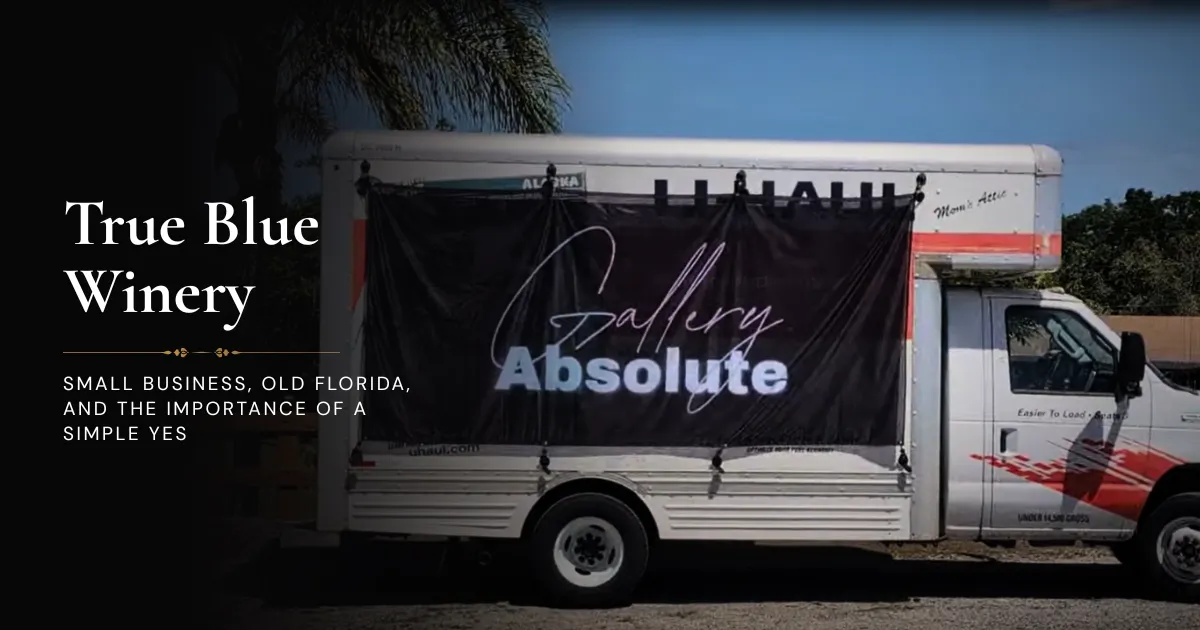
The response was completely different. They answered. They asked questions. They wanted to know what the project was, why I wanted to come to their business, what kind of space I needed, and how soon I could get there. True Blue Winery in Davenport was the first small business to say yes, and Howard and Fatima could not have been more welcoming.
I want to be clear that True Blue was not the first stop on the Florida Field Guide tour. I had already taken the mobile gallery to Sundresses in the Park in Auburndale. But there, I was a vendor participating in someone else's event. True Blue was different because it was the first time the mobile gallery itself was the event. There was no festival already happening around me. No larger crowd I was plugging into. Howard and Fatima simply made room for this weird little traveling gallery and said, essentially, “Sure. Come on out.”
That yes was more significant than I think they knew. They let me promote the visit and run Facebook ads. When FOX 13 wanted to come out and interview me about the Florida Field Guide tour, Howard and Fatima welcomed the reporter onto the property too. Every time I asked whether something was possible, their response seemed to be some version of, “Sure, we can figure that out.”
True Blue also happened to make an enormous amount of sense as a place for the Florida Field Guide. It is a blueberry farm as well as a winery and restaurant, and part of its story is rooted in Howard and Fatima choosing not to simply sell their land to developers. Instead, they built something on it. They grow blueberries, make wine, serve food, and created a place that still feels connected to the piece of Polk County underneath it.
That is important to me because the Florida Field Guide is also about place. It is about noticing what is already here, understanding what belongs here, and paying attention to the species and landscapes that shaped Florida before so much of it became pavement, rooftops, and subdivisions. True Blue is obviously a business, but it does not feel disconnected from the land around it. The fit felt natural.
The day itself was also extremely Polk County. I am not sure everyone outside Polk County will understand exactly what I mean by that, but there is a rhythm to the place I grew up. It is hot. It is slow. It is country without making a performance out of being country. There is a certain front-porch-and-sweet-tea quality to it, and you cannot go barging into relationships at full speed.
Polk County old-timers will get spooked.
You show up. You talk. You sit for a while. You let people figure out who you are. Trust grows at its own pace, and trying to rush it generally accomplishes the opposite--especially on the east side of Polk County.
That is more or less how our day at True Blue ended. After the gallery closed up, Howard and Fatima, my husband Tom, and I sat on the front porch of the winery chatting about overdevelopment, sandhill cranes, and a guy named Dave whom I had never met but who apparently loves sandhill cranes and whom I should definitely meet. We relaxed for a while before finally calling it a day. There was no dramatic finale and no reason to manufacture one. It was four people sitting on a porch after a hot Florida day, talking for a while before everybody went home. Honestly, it was perfect.
One of my favorite conversations from the day came from a group of four people who had not planned to visit the mobile gallery at all. They were coming from Tampa and heading toward the Disney area. They needed somewhere to stop for lunch, searched Google Maps along the route, found True Blue, and pulled in.
That, too, is very Polk County. For much of my life, this has been the place between Tampa and Orlando. People drove through Polk County on their way to somewhere else. Especially after Cypress Gardens closed, it sometimes felt like our primary geographic identity was being located between two places tourists actually intended to visit. Polk County old-timers prefer it that way: newcomers are best when they are just passing through.
These four people were doing exactly that. They were passing through. Then they stopped. They ate lunch, discovered the mobile gallery, came inside, and started looking at the artwork. One of the men began talking about the gopher tortoises that lived around his home when he was growing up. The conversation moved into Old Florida and how much he missed parts of it. He was delighted to have stumbled across a place like True Blue, and suddenly a lunch stop between Tampa and Kissimmee had turned into a conversation about wildlife, memory, childhood, and the Florida he remembered. That is exactly what I want the Florida Field Guide to do.
I do not need every meaningful encounter with the work to happen inside a museum, gallery, or fine art show. In some ways, I think it becomes even more interesting when people encounter it in the middle of ordinary life. They are on their way somewhere else. They stop for lunch. They have a glass of wine. They walk through a mobile gallery they did not know would be there, see an animal they recognize, and suddenly they are telling me a story about the gopher tortoises in their childhood yard.
The artwork becomes a doorway into something they were already carrying with them.
True Blue taught me something else too. Early in the grant project, I had assumed that institutional support would provide legitimacy. I thought municipalities, civic programs, and official event calendars would be the obvious infrastructure for moving a mobile gallery through the community. There is certainly a place for those relationships, but they were not what got this project moving.
Small businesses did.
People like Howard and Fatima did not need to understand every possible outcome before they opened the door. They saw an interesting idea that fit their place, they liked what I was trying to do, and they were willing to make room for it. That kind of hospitality created opportunities I had struggled to manufacture through more formal channels.
True Blue gave the mobile gallery its first opportunity to stand completely on its own. It gave FOX 13 a place to tell the story of the tour. It introduced me to people who would never have attended one of my art shows because they were simply looking for lunch on the way to Disney. And it gave me a relationship with two people I genuinely enjoyed getting to know.
The tour did not move forward because every big door opened. It moved because the right small ones did.
I am incredibly grateful that Howard and Fatima opened one of the first doors. And when True Blue opens back up for the season, I would very much like to take the mobile gallery back out there, see them again, spend another day talking about Florida, and hopefully end it exactly the same way. On the porch, with a glass of blueberry wine.


