Visit Central Florida Welcome Center
Visit Central Florida Welcome Center
Permission, possibility, and what a $5,000 grant "made" me do
There is panic that comes from getting exactly what you asked for.
When I applied for a $5,000 Arts & Culture Impact Grant from the Polk Arts & Culture Alliance, I had written a pretty ambitious proposal. I wanted to take the Florida Field Guide out into Polk County, particularly into communities on the east side where access to fine art and arts organizations can be more limited. I wanted to use wildlife art as a way to talk about conservation, local culture, and the arts organizations already doing good work here.
Then I got the grant.
For a minute, I felt a little like the dog who finally caught the mail truck.
Okay.
Now what?
The grant paid for the mobile gallery buildout, truck rentals, travel, and the infrastructure I needed to actually move the Florida Field Guide around the county. Five thousand dollars is not a life-changing amount of money in a business, but what the grant forced me to do absolutely changed the trajectory of mine.
It made me reach out to people. It made me build partnerships. It made me explain what I was doing to organizations that had never heard of me. And, maybe most importantly, it gave me enough outside credibility to believe I belonged in some of those conversations in the first place. That part started before I ever applied.
Dr. Daryl Ward, who was then the executive director of the Polk Arts & Culture Alliance, had invited me to participate in a panel discussion connected to a Florida Wildlife Corridor Foundation mural unveiling at the RP Funding Center. Samara Ash, Kelly Quinn, Mason Gravley, Daryl, and I sat together on stage taking questions about arts, conservation, and Polk County. That experience stuck with me.
The Florida Wildlife Corridor Foundation was already showing me one version of something I deeply believed: art can give people another way into conservation. It can create curiosity. It can make someone stop long enough to care about a place or species they might otherwise overlook.
Later, I attended Daryl’s State of the Arts in Polk County address in Mulberry. He talked about the Arts & Culture Impact Grants, and when the application opened, I went to look. Then I wrote the proposal.
Part of what I wanted to do was create a small, local version of what I had seen happening around the Florida Wildlife Corridor Foundation: use artwork to open the door, then let the conversation expand into wildlife, conservation, place, and community.
The Visit Central Florida Welcome Center in Davenport ended up being one of the clearest examples of that idea.
Visit Central Florida exists to tell people what there is to see and do in Polk County. Legoland. SUN ’n FUN. Local businesses. Outdoor recreation. Attractions. The arts. The Welcome Center itself is part visitor information center, part little introduction to the county, with displays about things like water skiing, citrus, and local history.
It made sense to park the mobile gallery there. Not because I expected a huge art-buying crowd. I did not. The Welcome Center is not an art festival. People pass through. Some are tourists. Some are looking for information. Some are probably trying to figure out what to do between Orlando and Tampa.
I thought the Florida Field Guide could function almost like an ambassador. Come look at the artwork. Then stay for the larger conversation about Polk County and conservation.
I ran Facebook event ads because I knew I could not rely entirely on the Center’s everyday foot traffic, and people did come out specifically to see the gallery. I talked about the Florida Field Guide, wildlife, conservation, the Florida Wildlife Corridor, the Polk Arts & Culture Alliance, and other cultural organizations in the county.
The artwork was the invitation. The larger conversation was Polk County. At one point, an older couple pulled into the parking lot. They slowed down when they saw the mobile gallery. A lot. They looked at the truck, pulled into a parking space, backed out, drove past it again, circled the parking lot, and eventually returned to the same spot. I watched this entire process.
They finally got out and went into the Welcome Center. When they came back out, they approached cautiously and asked if they were allowed to come inside the gallery and look around.
Of course! That was the whole point. There was something about the question that stayed with me. Maybe because there is something about Polk County hospitality that makes it almost strange. If we put something out where people can see it, we expect you to come over and ask what we are doing. Come look. Ask questions. Tell me where you are from. Tell me about the alligator that used to live behind your house. Tell me about the sandhill cranes you saw on the drive over. You are already here. Come on in.
And somewhere in that interaction was a strange parallel to what the grant had done for me. Because I had spent plenty of time wondering whether I was allowed to approach certain organizations too. Could I email Visit Central Florida? Could I ask a conservation organization to work with me? Could I show up in these spaces and talk about the role art could play? Would anybody take me seriously? The Arts & Culture Impact Grant helped answer that question. It opened the door and said yes. Come on in.
There were emails I sent with PACA Arts & Culture Impact Grant Award Winner in the subject line that I genuinely do not know would have been opened otherwise.
That mattered. Not because the grant suddenly made my artwork better. Not because $5,000 transformed my business overnight. Because it provided context. Someone had reviewed the project. Someone had decided it had public value. Someone had trusted me with money to make it happen. That gave other organizations a reason to listen. It also gave me a reason to stop standing outside wondering whether I was allowed to knock.
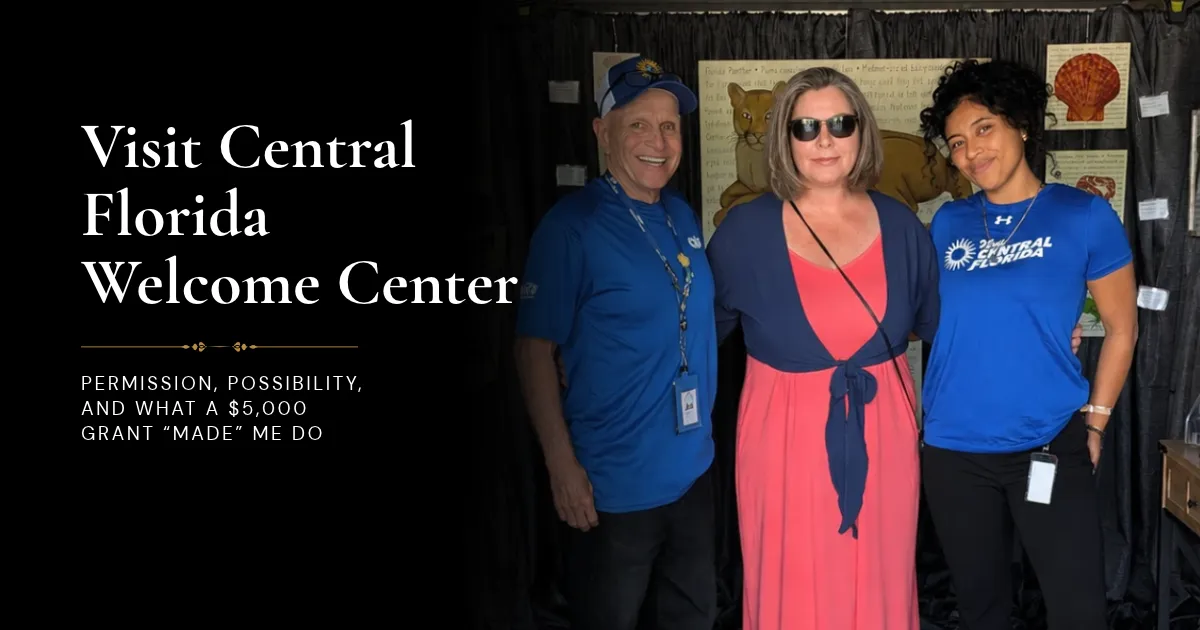
The Welcome Center staff gave me another small reminder of that during the day. The event happened the same weekend as SUN ’n FUN, which is one of the largest tourism events in Polk County. Most of the Visit Central Florida activity was happening there, while two staff members remained behind to run the Welcome Center. During a lull, they came outside to see the gallery. They took pictures inside the truck. They took pictures with me. They seemed genuinely excited to have something happening at the Welcome Center while everyone else was over at SUN ’n FUN.
They never said, “We were feeling left out.” That would be me assigning them feelings they did not express. But the vibe was there. They had their own thing happening too. And I liked that.
The Visit Central Florida stop was not the biggest stop on the tour. It was not the busiest. It did not produce some enormous sales day or dramatic revelation. But it was exactly the kind of relationship-building piece the grant made possible. I met people I would not have met otherwise. I got to talk about arts and conservation inside an organization whose entire purpose is introducing people to Polk County.
And I got to practice something I had not really understood was part of the project when I first wrote the grant application: being an ambassador. Not just for my artwork. For Polk County arts and culture. For conservation. For the Florida places and species that make people want to come here in the first place. For the organizations doing good work around me.
That has become one of the biggest outcomes of the grant. The mobile gallery was the thing I proposed. The relationships were the thing I built. And those relationships kept growing long after individual tour stops ended.
So I am grateful to Dr. Daryl Ward for creating some of those early opportunities and giving my work a literal stage before I was entirely sure where it was going.
I am grateful to the Polk Arts & Culture Alliance for trusting an ambitious proposal and giving me enough money, structure, and accountability to force the idea out of my studio.
And I am grateful to Visit Central Florida for opening the door, letting me park an art gallery outside the Welcome Center, and giving me a place to practice being part of a larger story about Polk County.
Five thousand dollars did not change my life. Being trusted with it did.


